
Tracking your tretinoin (Retin-A) journey, purge and all
What to expect from tretinoin (Retin-A) week by week, including the purge, and how to track progress photos so you can see whether it's working.
The short answer
Tretinoin (one brand name is Retin-A) is a topical retinoid: a cream, gel or lotion you put on your skin. It works by unclogging pores, and it can treat blackheads, whiteheads and some pimples. Dermatologists also use retinoids as a maintenance treatment once acne is under control.
It’s a prescription medicine in the US and the UK, and it isn’t quick. Acne may get worse in the first week or so, and the American Academy of Dermatology says acne treatments generally take at least 6 to 8 weeks before you start to see fewer breakouts.
A typical timeline
Your prescriber will tell you what to expect, but for many people it looks something like this:
- Days 1 to 10: the purge. MedlinePlus says acne will probably get worse during the first 7 to 10 days, with red, scaling skin and more spots, and advises carrying on with the medication through this.
- Weeks 2 to 6: acne sores often start to improve after 2 to 3 weeks of regular use, sometimes taking more than 6 weeks.
- Throughout: dryness, peeling, redness, itching, burning or stinging where you apply it are common. Tell your doctor if they’re severe or don’t go away.
- Weeks 6 to 8 and beyond: the American Academy of Dermatology says acne treatments generally take at least 6 to 8 weeks before you see fewer breakouts, so this is the earliest point to judge how it’s going.
Sun matters too. MedlinePlus advises avoiding unnecessary sun and tanning beds and wearing sunscreen over the treated areas. If you’re pregnant, planning a pregnancy or breastfeeding, tell your doctor before using it.
What’s worth tracking
- Progress photos at the same time and in the same light every day. The purge is far less scary when you can see it start and stop.
- Pimple count and how your skin feels. Peeling, tight and stinging in week one, calmer later.
- Side effects you notice, like dryness, redness or irritation, and when they eased.
- When you started, and any changes your prescriber makes.
- Your routine around it: moisturiser, sunscreen, cleanser, anything new.
How to track it in SkinTheory
- Set a hypothesis, like “Tretinoin reduces my breakouts within 8 weeks”.
- Take three photos a day (front, left and right) in each entry.
- Log skin feeling, mood and pimple count alongside them.
- Add tretinoin to your skincare routine, with your moisturiser and sunscreen, so every entry shows what you were using.
- Set routine reminders for morning and night with custom repeats.
- Use the photo timeline as your before and after, and the graphs to watch your pimple count over the last 21 entries.
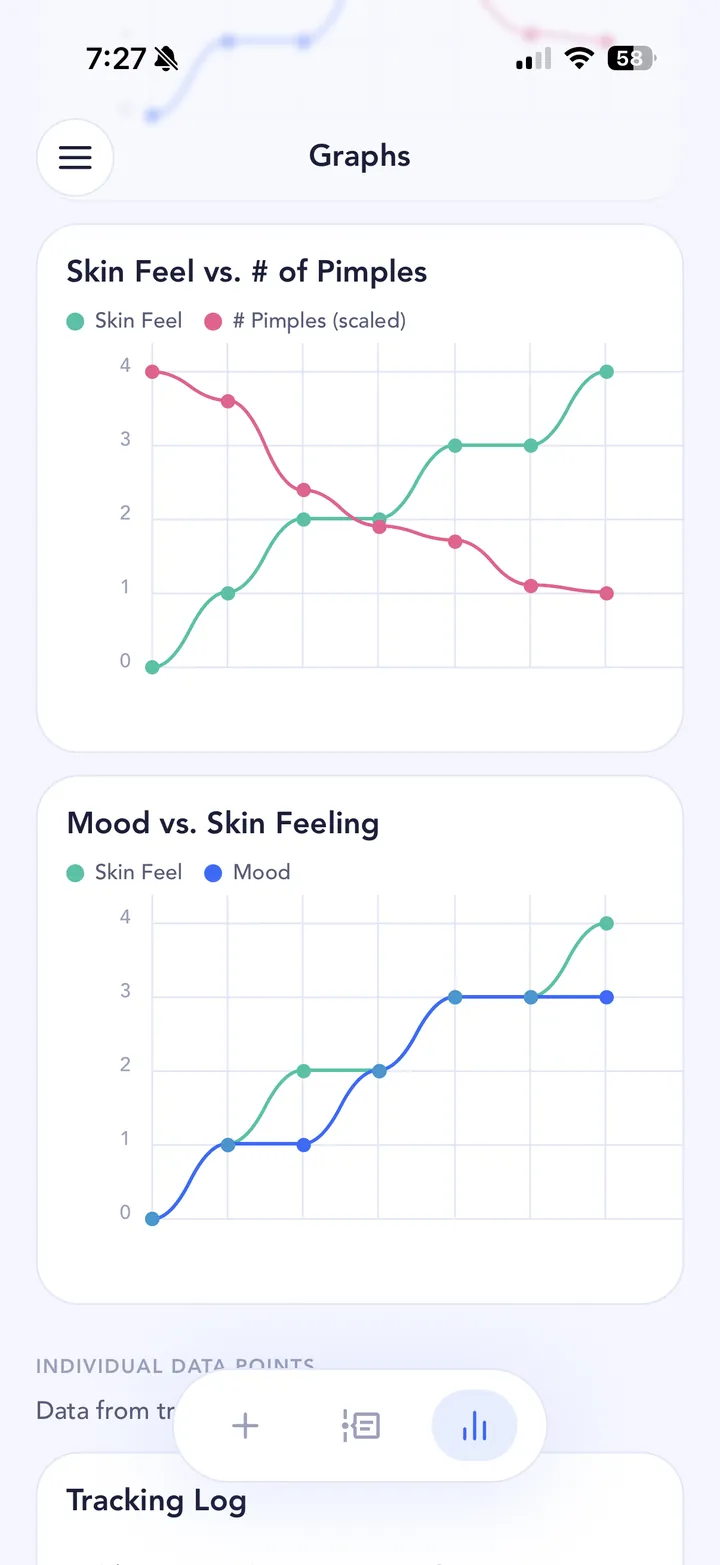
Was it the treatment, or something else?
This is the big question with tretinoin. Is a flare in week two the purge, or the pizza and three late nights? Is your skin still bad in week eight because the tretinoin isn’t working, or because of your period?
While you’re on the treatment, log the rest of your life too. SkinTheory’s Lab+ trackers cover Exercise, Dairy, Fast food, Sleep, Alcohol, Water, Protein and Period. Your own data is free forever, and any two Lab+ trackers can be used free at a time. The graphs line your pimple count up against them, so you can see whether a flare lines up with the treatment or with your life.
Worth reading while you track:
- Dairy and sugar
- Your period
- Alcohol, sleep and stress
- The gym and your bedsheets
- New skincare products, easy to blame on the tretinoin when it’s actually the new moisturiser
Keep the record
Photos stay private in SkinTheory and never go to your camera roll. You can keep the whole history on your phone for years, so if your skin changes after you stop or switch treatment, you can compare it with the first time.
Take your log to your appointments. “It got worse for about ten days, then started settling in week three” is a lot more useful to a dermatologist than “I think it’s working?”.
A note from Conor
Tretinoin was one of the treatments I worked through for severe adult acne in my early twenties, along with benzoyl peroxide, Differin and Accutane. The acne kept coming back and I didn’t know why. Back then my photos were in Flickr and my notes were in one long Google Doc. What finally worked for me was getting scientific about it, plus a gentler routine: moisturising more, keeping my skin clean without stripping the oils, and removing products rather than adding them.
Questions people ask
How long does the tretinoin purge last?
MedlinePlus says acne will probably get worse, with red, scaling skin and more spots, during the first 7 to 10 days of using tretinoin, and advises carrying on with the medication. It’s different for everyone, so if a flare lasts longer or worries you, talk to your prescriber rather than changing anything yourself.
When does tretinoin start working?
MedlinePlus says acne should start to improve after 2 to 3 weeks of regular use, and sometimes it takes more than 6 weeks. The American Academy of Dermatology says acne treatments generally take at least 6 to 8 weeks before you see fewer breakouts, so give it time and keep a daily photo record.
Is it a purge or a reaction to something else?
It’s hard to tell from the mirror. Logging diet, sleep, exercise and your cycle alongside your photos in SkinTheory lets the graphs show whether a flare lines up with starting tretinoin or with something else. Bring the log to your prescriber.
Can I track tretinoin side effects like peeling and dryness?
Yes. Log how your skin feels in each entry, such as dry, peeling or irritated, and your photos show it too. If irritation is severe or doesn’t go away, tell your doctor.
Sources and further reading
- Tretinoin Topical: MedlinePlus Drug Information, MedlinePlus (U.S. National Library of Medicine)
- Acne: Diagnosis and treatment, American Academy of Dermatology
- Acne, NHS
This guide is general information written by the SkinTheory team, not medical advice. SkinTheory isn’t a medical device. For diagnosis, prescriptions or side effects, talk to a dermatologist or doctor, and bring your SkinTheory log along.