
Does dairy cause acne?
Possibly. Large studies link milk, especially skim milk, to slightly higher odds of acne, but that's an association, not proof. Test your own skin.
The short answer
There’s some evidence, but no proof. Several large studies link drinking cow’s milk to slightly higher odds of acne, and the link looks a little stronger for skim milk. All of these studies are observational: they show an association, not that dairy causes acne, and nobody has run a controlled trial to check. The evidence for cheese and yoghurt is weaker and inconsistent. Studies only show averages, so they can’t tell you whether dairy matters for your skin. Testing it on yourself is the only way to find out.
What the research says
The American Academy of Dermatology (AAD) says some studies suggest drinking cow’s milk may be linked to more breakouts, and that whole, low-fat and skim milk have all been linked to acne. In the largest study it cites, 47,355 US women recalled their high school diets, and those who drank two or more glasses of skim milk a day were 44% more likely to have had acne. Recalling what you ate years ago is not very reliable, which is one reason this kind of study can’t prove anything on its own. The AAD says no studies have found that yoghurt or cheese lead to more breakouts. One theory is that hormones in milk cause inflammation, but the AAD says more research is needed.
The biggest summary is a 2018 meta-analysis of 14 observational studies covering 78,529 people aged 7 to 30. People who had any dairy had about 25% higher odds of acne than people who had none. The link was a little stronger for low-fat and skim milk than for whole milk, and for drinking milk daily rather than occasionally. But the links got weaker once the authors adjusted for other factors, they found signs of publication bias and big differences between studies, and they said the results “should be interpreted with caution”.
A second 2018 meta-analysis also found that milk, including skim and low-fat, was linked to acne, but it found no significant link for yoghurt or cheese. A 2022 systematic review in JAAD International called the dairy evidence “mixed”, and said any effect may depend on sex, ethnicity and diet, for example showing up more in places where a Western diet is common. In adults, a French study of about 24,000 people found milk was only weakly linked to current acne.
A 2026 review of drinks and skin health sums it up: milk is associated with acne in observational studies, but current acne guidelines don’t make formal dietary recommendations.
So the honest summary is: there’s a fairly consistent but modest link with milk, a weaker and inconsistent one for other dairy, and no proof of cause and effect.
Why it varies from person to person
An average across 78,000 people can hide a lot. A modest average effect could mean dairy makes a big difference for a smaller group of people and none at all for everyone else, or a small difference for most people. Studies can’t tell you which is true, or which group you’re in.
There’s also a lot going on around dairy in a normal diet. Milkshakes, ice cream and sweet coffees bring sugar with them, which has its own possible link to acne. Cutting dairy often means changing other foods too. And acne moves around on its own: hormones, your period, stress and sleep all shift from week to week. A two-week “dairy-free” stretch that happens to land on a calm, well-slept fortnight can look like a miracle when it isn’t.
How to test it on your own skin
This is the kind of question SkinTheory was built for: getting scientific about your skin with your own data, so you can isolate what actually matters for you. The AAD suggests something similar: notice whether a food seems to trigger breakouts, and what happens when you don’t have it.
- Hypothesis. Write down the question you want answered, for example “Does dairy make my chin break out?” In SkinTheory you can set this up as a hypothesis and test it over 21 entries.
- Track. Each entry, take your three skin photos and log your skin feeling, mood and pimple count, plus the Dairy tracker. Either keep eating dairy as normal for a stretch and then cut it, or simply log it honestly and let the graph show you the pattern. The important part is to keep everything else the same: same skincare routine, same products, no new treatments started mid-test.
- Analyze. After about 21 entries (3 weeks if you log daily), compare your Dairy log against your pimple count in the graphs, and scroll the photo timeline to see whether your chin actually looks different. Acne changes slowly (the AAD says even proven treatments take at least 6 to 8 weeks to reduce breakouts), so if the first round is unclear, keep going.
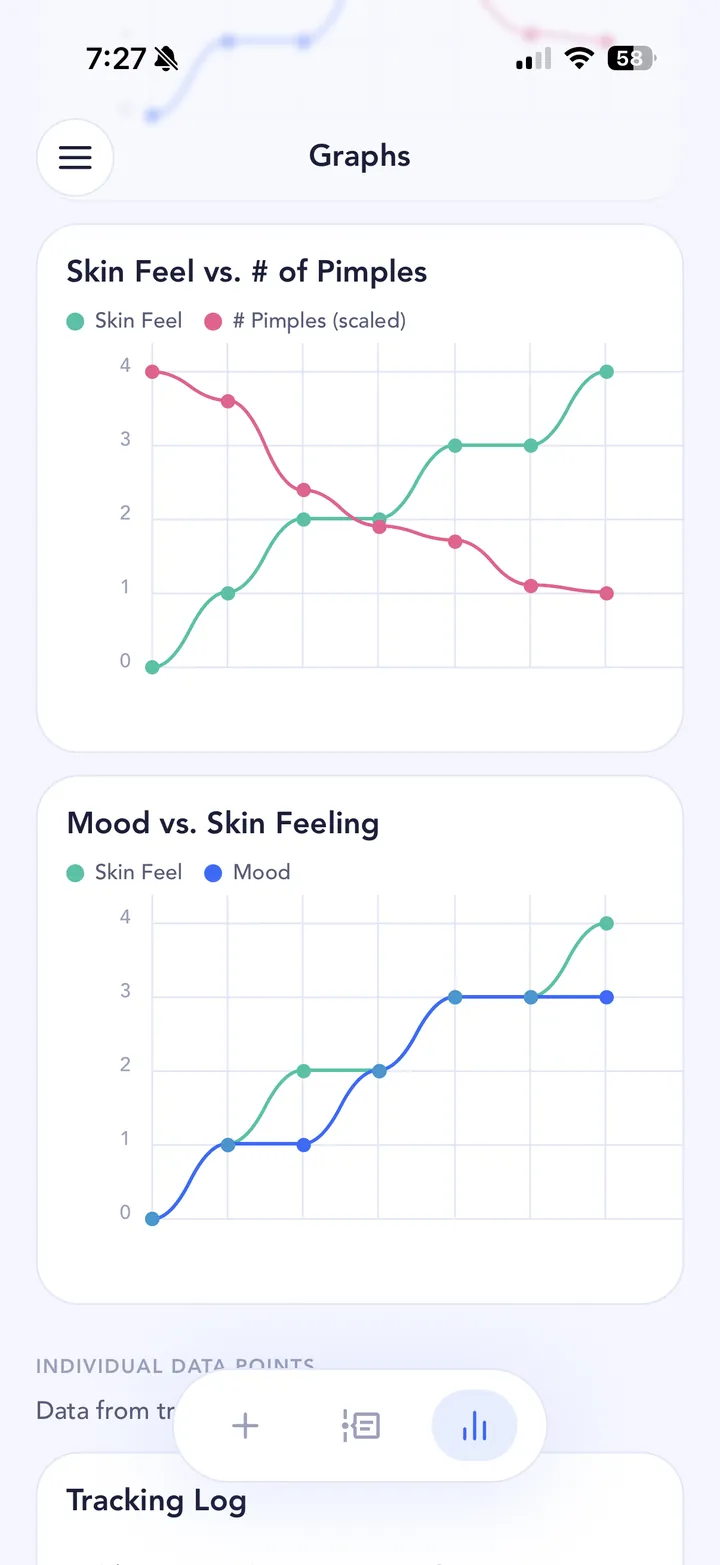
Your photos stay inside SkinTheory, never in your camera roll, and you can keep your whole history on your phone for as long as you like. The Dairy tracker is one of the Lab+ trackers, and you can use any two Lab+ trackers for free at a time.
Tips while you test
- Test one thing at a time. If you cut dairy and sugar in the same week, you won’t know which one did it.
- Watch for hidden swaps. Oat-milk lattes with syrup aren’t a like-for-like change.
- Dairy is a whole food group. Before cutting it for more than a short test, talk to a doctor or dietitian, especially if you’re a teenager, pregnant or breastfeeding, or have a history of disordered eating.
- If your acne is painful, scarring or affecting how you feel, see a doctor or dermatologist rather than relying on diet changes. The AAD says clear skin takes more than a diet change.
Dairy is rarely the only thing going on. If your breakouts follow a monthly pattern, read about hormonal acne and your period; if you’re drinking protein shakes, see the gym guide. And if you’re on a treatment, keep logging dairy alongside it in SkinTheory so you know whether it’s the treatment or your life that’s changing your skin.
Questions people ask
Does skim milk cause more acne than whole milk?
A 2018 meta-analysis of 14 studies found a slightly stronger link with low-fat and skim milk than with whole milk, but all types of cow’s milk have been linked to acne. These are observational studies, so nobody has shown that skim milk itself causes the difference.
Do cheese and yoghurt cause acne too?
The evidence is weaker and less consistent than for milk. One 2018 meta-analysis found small associations for cheese and yoghurt, while another found no significant link, and the AAD says no studies have found that they lead to more breakouts. If you’re curious, test them separately from milk so you know which one you’re reacting to.
How long should I cut out dairy to see if it helps my acne?
Acne changes slowly: the AAD says even proven acne treatments take at least 6 to 8 weeks to reduce breakouts, so a few days tells you very little. Keep your skincare routine and everything else the same, and compare your pimple count and photos with the weeks before. If you plan to cut dairy for more than a short test, talk to a doctor or dietitian first.
Is whey protein the same as dairy for acne?
Whey is a milk protein, but the milk studies mostly looked at drinking milk, not protein supplements. Our gym and sweat guide covers what’s known about whey and acne.
Sources and further reading
- Can the right diet get rid of acne?, American Academy of Dermatology
- Dairy Intake and Acne Vulgaris: A Systematic Review and Meta-Analysis of 78,529 Children, Adolescents, and Young Adults, Nutrients (2018), via PubMed
- Dairy intake and acne development: A meta-analysis of observational studies, Clinical Nutrition (2019), via PubMed
- Diet and acne: A systematic review, JAAD International (2022), via PubMed
- Association Between Adult Acne and Dietary Behaviors: Findings From the NutriNet-Santé Prospective Cohort Study, JAMA Dermatology (2020), via PubMed
- Dietary beverages and cutaneous health: Mechanisms, clinical evidence, and practical implications for dermatologists, Clinics in Dermatology (2026), via PubMed
This guide is general information written by the SkinTheory team, not medical advice. SkinTheory isn’t a medical device. For diagnosis, prescriptions or side effects, talk to a dermatologist or doctor, and bring your SkinTheory log along.