
Is my new skincare product causing acne? Purging vs breaking out
Some acne treatments can make acne look worse at first, though how often is debated. Other products can clog pores. Photos from before you start help tell them apart.
The short answer
It depends on what the product is. Some acne treatments, especially retinoids like adapalene, carry a warning that acne may look worse in the first few weeks. People call this “purging”, but how often it really happens is debated, and acne goes up and down on its own anyway. Other products, like a heavy moisturiser, foundation or powder, can clog pores and are linked to breakouts in some people, though the studies are small. Whether the product is an active treatment, when spots started and where they appear are useful clues, and photos from before you started make the answer much clearer.
What the research says
“Purging” isn’t a formal medical term, but the effect behind it is real for some treatments. The prescribing information for the adapalene cream Differin says that “during the early weeks of therapy, an apparent exacerbation of acne may occur”. The same label says some benefit may show after two weeks, but at least eight weeks are needed for consistent results.
The evidence behind that warning is weaker than its reputation. A 2009 review looked for clinical trial data showing acne getting worse when people start topical retinoids and found none. It concluded that early worsening was unlikely to be caused by the retinoid, and that some people’s acne gets worse in the first week or two simply because acne fluctuates. A 2008 analysis of trial data did find a flare in a subset: about 15% of people with mild acne using tretinoin alone had more inflamed spots at two weeks, compared with about 9% on a plain gel. So an early flare can happen, but it doesn’t seem to happen to most people, and it’s hard to tell apart from normal ups and downs without a record.
Something similar can happen with oral treatment. The American Academy of Dermatology says that when you start isotretinoin, acne may worsen for 1 to 2 months before it begins to clear, although it says this doesn’t happen to most patients.
Cosmetic products are a different story. The AAD’s list of skin care habits that can worsen acne recommends products labelled “non-comedogenic” or “won’t clog pores”, and warns against sleeping in makeup and switching acne treatments too often. It notes that complete clearing generally takes 3 to 4 months. A 2025 case-control study found that certain products, including face powders and cleansers containing pore-clogging ingredients, were linked to higher odds of acne, and that heavier moisturiser use was too. It was a small questionnaire study of 151 people, so it shows a link, not cause and effect, and it’s a signal rather than a rule. There’s no good evidence on which ingredients do or don’t cause purging, beyond the warnings on retinoid labels.
Why it varies from person to person
The same product can suit one person and break out another. Skin type, how oily or dry you are, what else is in your routine and how often you apply something all change the result. Adding several new products at once makes it impossible to tell which one is responsible.
This is personal for us. Conor, who built SkinTheory, had severe acne in his early twenties and tried benzoyl peroxide, tretinoin, Differin and Accutane, more than once. What finally worked for him was a gentler routine: moisturising more, not stripping his skin’s oils, and taking products away rather than adding more. That’s one person’s story, not advice, but it’s a good reminder that “more products” isn’t always the answer.
How to test it on your own skin
The best time to start tracking is before you open the new product. SkinTheory lets you get scientific about your skin with your own data, so you can isolate whether the product is the cause.
- Hypothesis. Set one up, for example “Is my new moisturiser making my cheeks break out?” or “Is adapalene purging or irritating my skin?” and run it for 21 entries.
- Track. Each entry, take your three skin photos and log skin feeling, mood and pimple count, and keep your skincare routine logged so the start date of the new product is clear. Add one new product at a time and keep everything else the same.
- Analyze. After about 21 entries (3 weeks if you log daily), compare pimple count and skin feeling before and after in the graphs, and use the photo timeline to see whether spots are in your usual areas or new ones. Dermatologists often suggest 6 to 8 weeks for real changes, and the Differin label says at least eight weeks for consistent effects, so don’t judge an active treatment too early. If you’re unsure, show your photos to your dermatologist or prescriber.
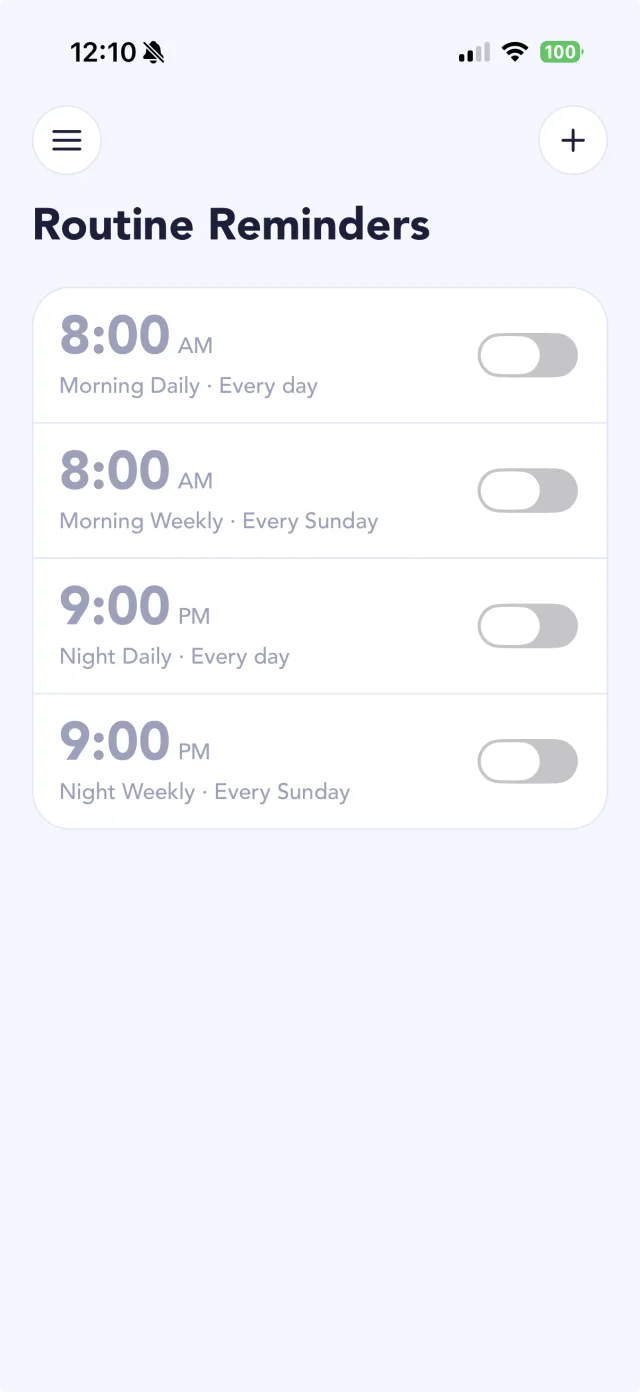
Routine reminders help you apply a new product consistently, so the test is fair. Your photos stay private in SkinTheory, never in your camera roll, and your history is yours to keep.
Tips while you test
- Introduce one product at a time, a few weeks apart.
- Take photos before you start. “Was it this bad before?” is hard to answer from memory.
- Stop and talk to a dermatologist or pharmacist if you get swelling, blistering, burning or a rash. That’s not purging.
- For prescription treatments, follow your prescriber’s instructions rather than general advice.
Bedtime products meet your pillow every night, so see pillowcases and bedsheets too, and the gym if you wear makeup or sunscreen while you train. If you’ve started a prescription treatment, the acne treatments guides cover tracking a treatment journey, so you know whether it’s the treatment or your life that’s changing your skin.
Questions people ask
How long does skin purging last?
There’s no fixed answer, and it hasn’t been well studied. The Differin (adapalene) label says acne can look worse in the early weeks of therapy, and the AAD says acne can worsen for 1 to 2 months when starting isotretinoin, though most people don’t get this. If things are still getting worse after several weeks, or your skin is painful or very irritated, talk to a dermatologist.
How can I tell if it's purging or a breakout?
There’s no proven test. A common rule of thumb is that purging comes with active acne treatments such as retinoids and shows up where you normally get spots, while new spots in unusual places after a moisturiser, makeup or sunscreen point more towards the product. Photos taken before and after starting, and advice from a dermatologist, make it much easier to judge.
Should I stop a product if my acne gets worse?
For a prescription or medicated treatment, ask the person who prescribed or recommended it before stopping, since an early flare can happen. For a cosmetic product, if new spots appear where you don’t usually get them, stopping it and watching what happens is reasonable. Stop and get advice if you have swelling, blistering, burning or a rash.
What does non-comedogenic mean?
It means a product is designed not to clog pores. The AAD recommends choosing makeup, sunscreen, skin and hair products labelled non-comedogenic or ‘won’t clog pores’, because they don’t cause breakouts in most people.
Sources and further reading
- DIFFERIN- adapalene cream (prescribing information), DailyMed, U.S. National Library of Medicine
- Isotretinoin: The truth about safety, side effects, and skin care, American Academy of Dermatology
- 10 skin care habits that can worsen acne, American Academy of Dermatology
- A Case-Control Study Exploring the Association Between Cosmetic Use and Acne Risk: Implications for Prevention and Clinical Practice, Clinical, Cosmetic and Investigational Dermatology (2025), via PubMed
- Do topical retinoids cause acne to "flare"?, Journal of Drugs in Dermatology (2009), via PubMed
- Retinoid-Induced Flaring in Patients with Acne Vulgaris: Does It Really Exist?, Journal of Clinical and Aesthetic Dermatology (2008), via PMC
This guide is general information written by the SkinTheory team, not medical advice. SkinTheory isn’t a medical device. For diagnosis, prescriptions or side effects, talk to a dermatologist or doctor, and bring your SkinTheory log along.