
The best way to track your acne
To find out what’s behind your breakouts, you need a record: what your skin looked like, and what was going on in your life at the time. Here’s how the common ways of keeping one compare.
The short answer
A good acne record has three things: photos taken the same way every day, a simple score (pimple count and how your skin feels), and your suspects logged right next to them, like dairy, your cycle, sleep, the gym or a new treatment. Most people manage one or two of those. SkinTheory is a free acne tracker app for iPhone and Android that does all three in one place, and keeps the photos out of your camera roll.
Side by side
| SkinTheory | Camera roll + notes app | Period or habit tracker | Memory + dermatologist visits | |
|---|---|---|---|---|
| Daily skin photos | Three a day (front, left, right) in one timeline | Yes, mixed in with everything else | No | Only at appointments, if at all |
| Photos stay private | Yes: never in your camera roll | No: they land in your camera roll and photo memories | Not applicable | Not applicable |
| Pimple count and skin feeling | In every entry | Only if you write it down | No | From memory |
| Suspects next to your skin (diet, cycle, sleep, gym) | Period, dairy, fast food, alcohol, protein, sleep, water, exercise | Scattered across notes | Your cycle or habits, but not your skin | From memory |
| Graphs | Pimple count against each tracker over your last 21 entries | No | For the habit, not your skin | No |
| Experiments | Hypotheses tested over a set number of entries | Manual | No | Your dermatologist’s plan |
| Tracking a treatment | Daily photos plus lifestyle factors alongside it | Manual | No | Check-ins every few weeks or months |
| Reminders | Multiple routine reminders with custom repeats | Set them yourself | For the habit | No |
| Price | Free for all your own data, forever; optional Lab+ | Free | Usually free or freemium | Appointment costs |
| Platforms | iPhone and Android | Any phone | Varies | Not applicable |
Camera roll and a notes app
This is where most people start, and it’s how SkinTheory started too: Conor, who built it, spent years keeping skin photos on Flickr so they wouldn’t show up in his camera roll, and his notes in one very long Google Doc. It works, but it’s fiddly. Close-ups end up next to your holiday photos, and to spot a pattern you have to line up dates across two apps yourself.
Period and habit trackers
Great at what they’re for. If you suspect hormonal acne, a period tracker tells you where you are in your cycle, but it doesn’t know what your skin looked like that day. Habit trackers have the same gap: the suspect is logged, the skin isn’t.
Memory and dermatologist visits
A dermatologist is the right person to diagnose and treat acne, and nothing here replaces one. But appointments are weeks or months apart, and memory is a bad judge of skin: a bad week feels like a bad month. Bringing daily photos and notes makes the appointment far more useful.
SkinTheory
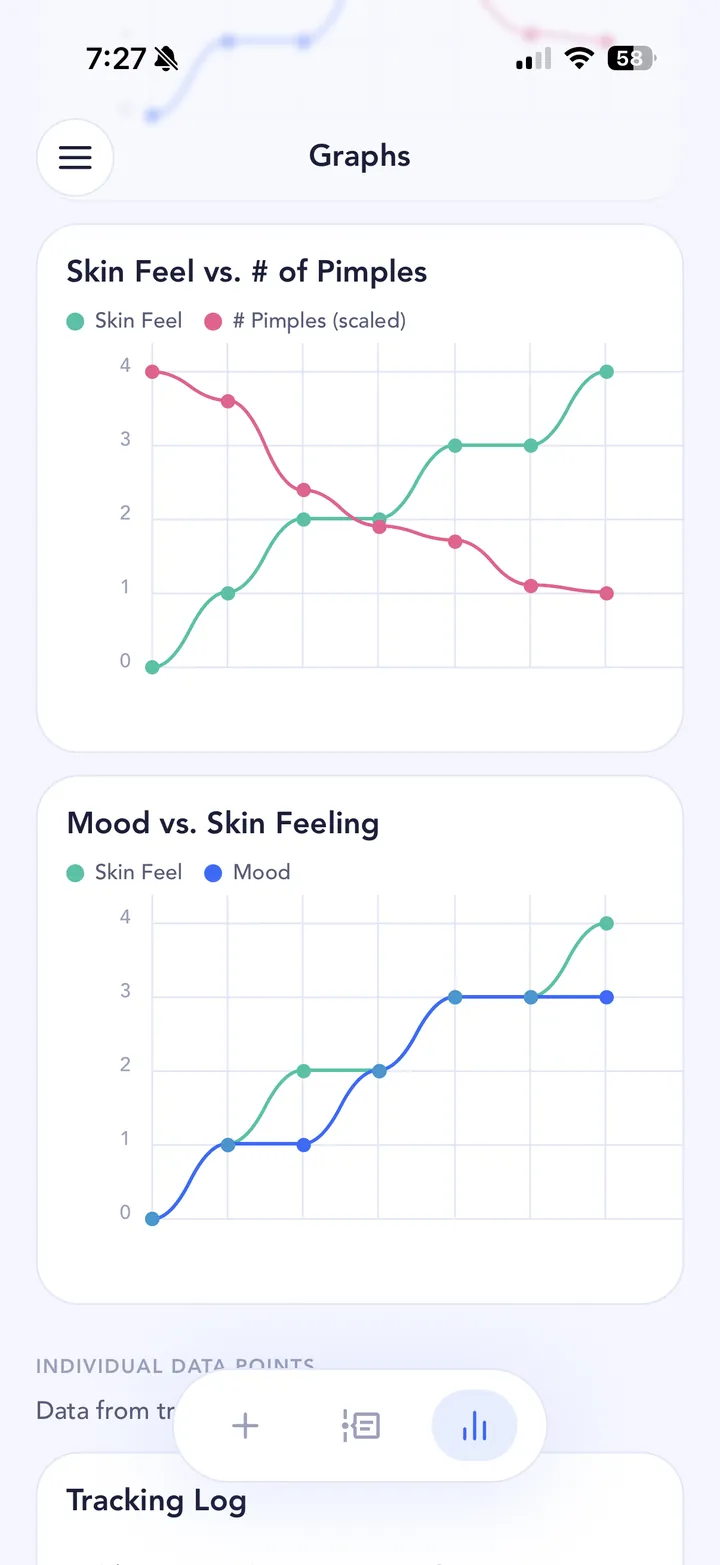
SkinTheory is built around the scientific method. You make a hypothesis (“Does dairy make my chin break out?”), track it with three photos a day plus your skin feeling, mood and pimple count, then analyse the graphs to see what lines up with your breakouts. If you’re on a treatment like Accutane or tretinoin, you can track that journey and still log the gym, your bedsheets, diet and sleep alongside it, so you know whether it was the treatment or something else.
When SkinTheory isn’t the right fit
- If your acne is sudden, severe, painful or scarring, see a doctor or dermatologist first. Tracking can wait.
- If you want an app to diagnose your skin or recommend products, SkinTheory doesn’t do that. It helps you test your own suspects.
- If you won’t take photos most days, a simple notes app might be enough for you.
Questions people ask
What is the best app to track acne?
Look for an app that keeps your skin photos private, logs pimple count and how your skin feels every day, and lets you log suspects like diet, your cycle, sleep or a new treatment next to your skin. SkinTheory is a free acne tracker for iPhone and Android built around exactly that, with graphs that line your breakouts up against your suspects.
Is there a free acne tracker app?
Yes. SkinTheory is free, and free for all your own data, forever. Lab+ is an optional upgrade with extra trackers and graph features, and any 2 Lab+ trackers can be used for free at a time.
Can I just use my camera roll and a notes app?
You can, and it’s how SkinTheory’s founder started. The downsides are that skin close-ups end up in your camera roll and photo memories, and you have to line up your notes and photos yourself to spot a pattern.
Should I use an acne tracker instead of seeing a dermatologist?
No. An acne tracker doesn’t diagnose or treat anything. It works best alongside a dermatologist: a few weeks of photos and notes make your appointment much more useful.