
Tracking your adapalene (Differin) journey
What to expect from adapalene (Differin) over the first 12 weeks, including early worsening, and how to take before and after photos that show if it's working.
The short answer
Adapalene (best known as Differin) is a topical retinoid, a gel or cream you put on your skin. Like other retinoids it helps unclog pores, and it can treat blackheads, whiteheads and some pimples.
In the US, an adapalene gel is sold over the counter, while other forms need a prescription. In the UK it’s prescription-only.
It’s slow. MedlinePlus says it may take 8 to 12 weeks or longer to feel the full benefit, and acne can get worse in the first few weeks.
A typical timeline
Everyone’s skin is different, and your pharmacist or dermatologist can tell you what to expect. For many people:
- Weeks 1 to 4: acne may get worse, and new pimples can show up. Redness, scaling, dryness and burning or stinging are most likely in the first 2 to 4 weeks.
- Weeks 4 to 8: MedlinePlus says irritation is most likely in the first 2 to 4 weeks, and you may start to see fewer breakouts. The American Academy of Dermatology says acne treatments generally take at least 6 to 8 weeks before breakouts reduce.
- Weeks 8 to 12 and beyond: the full benefit, if it’s going to work for you.
Sun matters too: MedlinePlus advises avoiding unnecessary or long exposure to sunlight and sunlamps and wearing sunscreen while you use it. If you’re pregnant, planning a pregnancy or breastfeeding, tell your doctor before using it.
What’s worth tracking
- Progress photos at the same time and in the same light every day, starting before your first use.
- Pimple count and how your skin feels. Weeks one to four can feel like a step backwards. A log shows whether it’s turning.
- Side effects you notice, like dryness, redness and stinging.
- When you started, and any change, like moving from the over-the-counter gel to a prescription.
- Your routine around it: moisturiser, sunscreen and anything you’ve added or dropped.
A few things make daily photos comparable: the same spot and the same light (a window in the morning, or the same lamp at night), hair back, no makeup, and roughly the same distance from the camera. Take your first entry before you start using it, so day one really is day one. Skipping a day isn’t a disaster; the timeline still shows the trend.
How to track it in SkinTheory
- Set a hypothesis, like “Adapalene clears my breakouts in 12 weeks”.
- Take three photos a day: front, left and right in every entry.
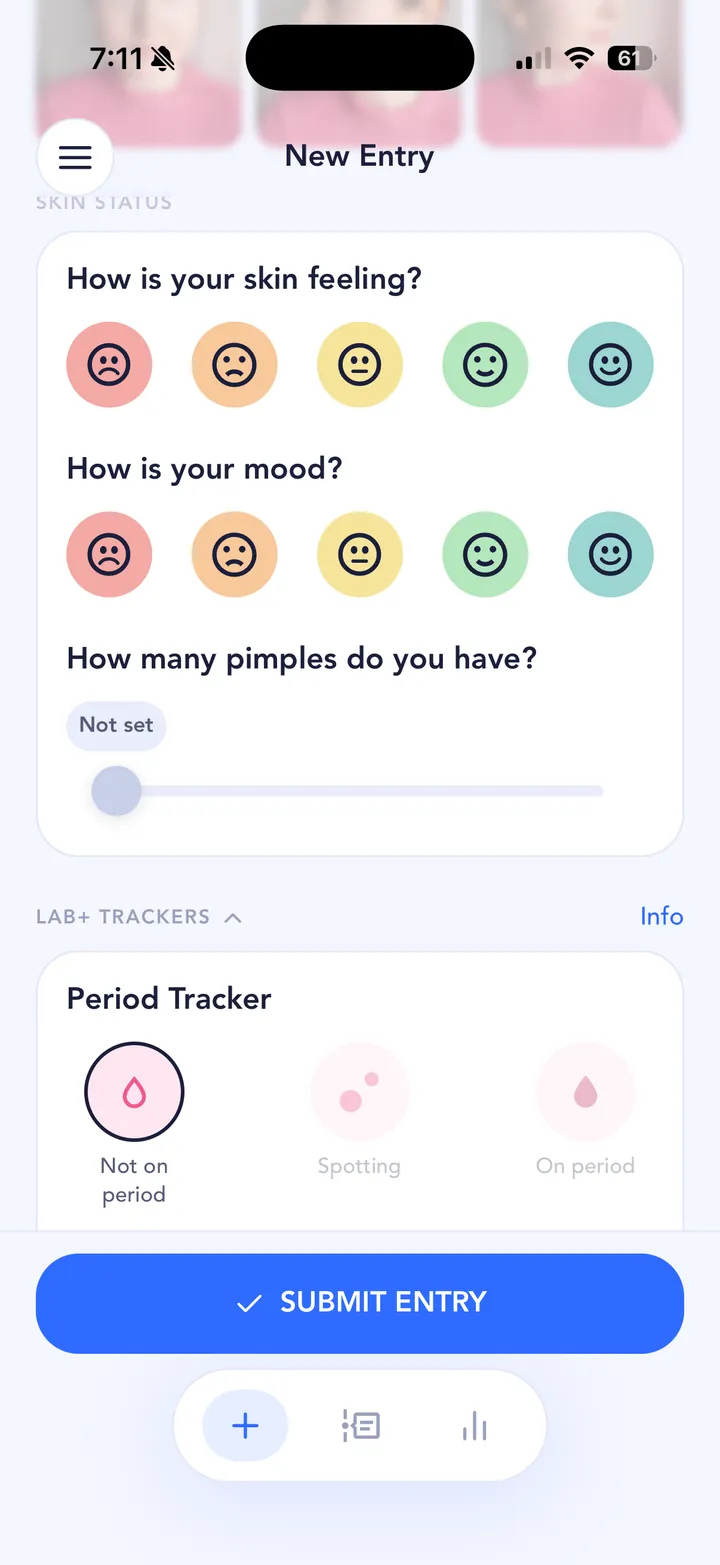
- Log skin feeling, mood and pimple count with the photos.
- Add adapalene to your skincare routine, next to your moisturiser and sunscreen.
- Set routine reminders for morning and night with custom repeats.
- Use the photo timeline as your before and after.
Was it the treatment, or something else?
Twelve weeks is a long time. Over that stretch you’ll have stressful weeks, late nights, maybe a period or two and a few takeaways. Any of them can land on top of the early adapalene flare and make it hard to tell what’s going on.
Log those alongside your treatment. SkinTheory’s Lab+ trackers cover Exercise, Dairy, Fast food, Sleep, Alcohol, Water, Protein and Period. Your own data is free forever, and any two Lab+ trackers can be used free at a time. The graphs line your pimple count up against them over your last 21 entries, so you can see whether a flare lines up with the treatment or with your life.
Worth a read:
- Dairy and sugar
- Your period
- Alcohol, sleep and stress
- The gym and your bedsheets
- New skincare products
Keep the record
Your photos stay private in SkinTheory and never go to your camera roll. Keep the whole record on your phone for as long as you like, so if breakouts come back months later you can compare them with the first time.
If you see a dermatologist, bring your log. Twelve weeks of photos and pimple counts make the conversation about what to try next much easier.
A note from Conor
Differin was one of the treatments I went through for severe adult acne in my early twenties, along with benzoyl peroxide, tretinoin and Accutane. My acne kept coming back and I didn’t know why. What finally worked for me was getting scientific about it, and a gentler routine: moisturising more, keeping my skin clean without stripping the oils, and removing products rather than adding them.
Questions people ask
How long does adapalene take to work?
MedlinePlus says it may take 8 to 12 weeks or longer to feel the full benefit of adapalene. Daily photos make slow change much easier to see than the mirror does.
Does adapalene make acne worse at first?
It can. MedlinePlus notes that acne may get worse during the first few weeks of treatment, and that redness, scaling, dryness and stinging are most likely in the first 2 to 4 weeks. If you’re worried about how your skin is reacting, ask your pharmacist or doctor.
How do I take adapalene before and after photos?
Take them before your first use, then every day at the same time and in the same light, from the front, left and right. SkinTheory takes three photos per entry and lines them up in a timeline, so your before and after builds itself, and they never go to your camera roll.
Is Differin prescription-only?
It depends where you live. In the US, an adapalene gel is sold over the counter, while other forms such as creams, lotions and solutions need a prescription. In the UK, the NHS lists adapalene as a treatment you get from a GP or specialist with a prescription.
Sources and further reading
- Adapalene: MedlinePlus Drug Information, MedlinePlus (U.S. National Library of Medicine)
- Acne: Diagnosis and treatment, American Academy of Dermatology
- Acne, NHS
This guide is general information written by the SkinTheory team, not medical advice. SkinTheory isn’t a medical device. For diagnosis, prescriptions or side effects, talk to a dermatologist or doctor, and bring your SkinTheory log along.