
Does your period cause acne? Hormonal breakouts and your cycle
For many people, yes. Surveys suggest roughly half of women notice acne flare before their period, but not everyone does. Tracking your cycle shows whether yours does.
The short answer
For a lot of people, yes. Hormone changes around your period are on every major dermatology list of acne triggers, and surveys suggest roughly half of women notice their acne get worse in the days before their period. The studies on how common it is are small or based on self-report, though. But not everyone has a cycle pattern, and plenty of “hormonal” breakouts turn out to have other causes. Tracking a few cycles is the quickest way to find out which camp you’re in.
What the research says
Hormones are on every major list of acne causes. The NHS lists hormone changes “such as during puberty, periods, menopause and pregnancy” as a cause of acne, and the American Academy of Dermatology’s adult acne page says women often have fluctuating hormones around their periods, during pregnancy, perimenopause and menopause, and after starting or stopping birth control pills, and that this can lead to breakouts.
How common is the period flare? In a 2001 study of 400 women, 44% said their acne got worse before their period. That flare was more common in women over 33. A smaller 2004 study actually counted spots across two full cycles in adult women who weren’t on acne treatment, and found most of them (63%) had at least a 25% rise in inflammatory spots before their period. A 2014 survey of adult women at a dermatology clinic found 65% said their acne got worse around their period, most often in the week before. DermNet sums it up simply: “Premenstrual flares are common.”
Those are useful numbers, with limits. Two of the studies relied on people’s memories, the 2014 one only included women already seeing a dermatologist for acne, and the study that actually counted spots was small. They all point the same way, though: a premenstrual flare is common, real, and far from universal.
Why it varies from person to person
Everyone’s hormones, cycle length and skin are different. Some people have a clockwork flare every month; some see nothing; some only notice it when other things pile up at the same time. The late part of the cycle often comes with other changes too: worse sleep, more stress, cravings for sugary food or dairy. Any of those can make it hard to tell whether it’s the hormones or the chocolate.
Contraception, pregnancy, perimenopause and conditions that affect hormones can all change the pattern. If your acne is sudden, severe, or comes with irregular periods or extra hair growth, talk to a doctor or dermatologist rather than tracking alone. The NHS lists irregular periods, excess hair growth and acne together as possible signs of polycystic ovary syndrome (PCOS, which the NHS now calls PMOS), something a GP can check for.
How to test it on your own skin
A cycle pattern is something you can see in your own data, which is exactly what SkinTheory is for: getting scientific about your skin and isolating what’s really going on.
- Hypothesis. Start with a clear question, for example “Do I break out on my chin the week before my period?” Set it up as a hypothesis in SkinTheory.
- Track. Each entry, take your three skin photos and log skin feeling, mood and pimple count, plus the Period tracker. Keep your skincare routine and products the same for the whole test, so the cycle is the main thing changing.
- Analyze. After about 21 entries (3 weeks if you log daily) you’ll have a first look, but for a cycle pattern you really want two or three full cycles. Acne changes slowly anyway: the AAD says acne treatments usually take 6 to 8 weeks before you see fewer breakouts. Compare your pimple count against your Period log in the graphs, and use the photo timeline to see whether the same areas flare at the same point each month.
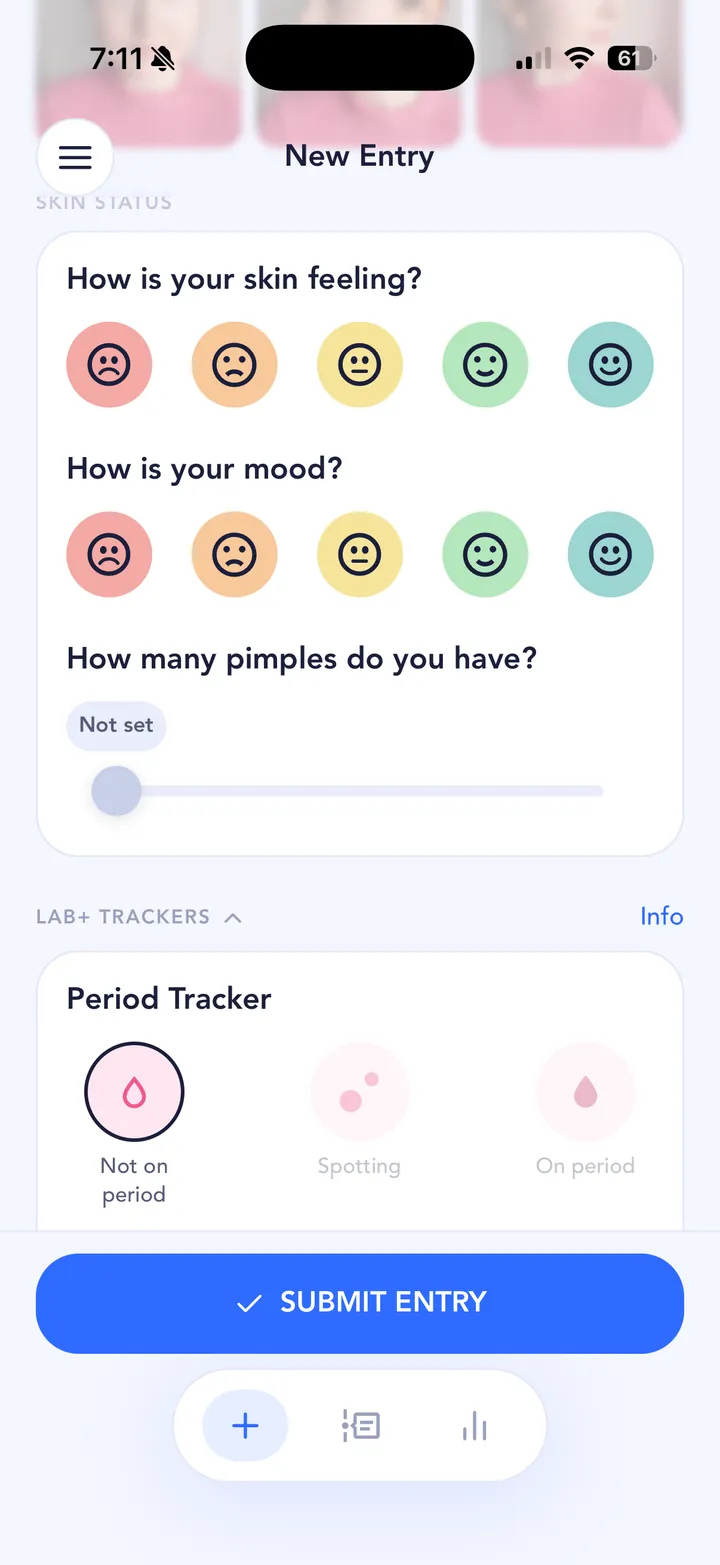
Your photos and cycle data stay private in SkinTheory, never in your camera roll, and you can keep years of history on your phone. Period is a Lab+ tracker, and any two Lab+ trackers can be used for free at a time.
Tips while you test
- Log your mood too. If your mood dips and your skin flares on the same days, that’s worth knowing, and worth mentioning to a doctor.
- Don’t start a new product halfway through a cycle. It makes the pattern impossible to read.
- If you do see a clear monthly flare, bring your graphs and photos to a dermatologist. Real data from several cycles is much more useful than “I think it’s hormonal”.
Hormones rarely act alone. If your flare lines up with cravings, read about sugar and fast food and dairy; if it lines up with bad nights, see sleep. If you’re on a treatment, log your period alongside it so you know whether it’s the treatment or your cycle that’s moving your skin.
Questions people ask
When in my cycle is acne usually worst?
Most people who notice a pattern see it in the week or so before their period starts, the late luteal phase. In one small study that counted spots in adult women, about two thirds (63%) had at least 25% more inflammatory spots before their period.
Why does period acne often show up on the chin and jaw?
DermNet notes that in adult acne, inflamed spots are common on the jawline and neck, but they can appear anywhere on the face, chest or back. There’s little research on where period breakouts specifically appear, so check your own with photos rather than assuming.
Can birth control affect acne?
It can. The AAD lists starting or stopping birth control pills as one of the hormone changes that can trigger breakouts, and some combined pills are also prescribed to treat acne. Don’t start, stop or switch contraception for your skin without talking to your doctor or dermatologist.
How many cycles should I track before I know?
At least two full cycles, and three is better. One cycle can be thrown off by stress, sleep or a new product. With SkinTheory’s Period tracker logged alongside your pimple count, the pattern either repeats or it doesn’t.
Sources and further reading
- Adult acne, American Academy of Dermatology
- Acne, NHS
- The effect of the menstrual cycle on acne, Journal of the American Academy of Dermatology (2001), via PubMed
- Quantitative documentation of a premenstrual flare of facial acne in adult women, Archives of Dermatology (2004), via PubMed
- Perimenstrual flare of adult acne, Journal of Clinical and Aesthetic Dermatology (2014), via PubMed Central
- Adult acne, DermNet
This guide is general information written by the SkinTheory team, not medical advice. SkinTheory isn’t a medical device. For diagnosis, prescriptions or side effects, talk to a dermatologist or doctor, and bring your SkinTheory log along.