
Tracking your Accutane (isotretinoin) journey
What a typical Accutane (isotretinoin) course looks like month by month, what's worth tracking, and how to keep progress photos and a log you can show your dermatologist.
The short answer
Isotretinoin, still widely known by the old brand name Accutane (Roaccutane in the UK), is a capsule taken by mouth for severe acne. Dermatologists usually prescribe it for nodular acne that hasn’t responded to other treatments.
It’s prescription-only and comes with close monitoring, mainly because it can cause serious birth defects or miscarriage if taken during pregnancy. In the US, isotretinoin is only available through the FDA’s iPLEDGE program, which is designed to prevent pregnancy during treatment. You’ll have regular follow-ups, usually monthly, and anyone who can get pregnant has pregnancy tests before and during treatment. The FDA approved changes to iPLEDGE in 2026, so ask your dermatologist how it works for you. In the UK, you’ll have regular check-ups and blood tests, and anyone who could get pregnant must use contraception from at least a month before the first dose until at least a month after the last.
A course typically lasts around 3 to 5 months, sometimes shorter or longer. The American Academy of Dermatology says clearance is often long-lasting and, for some people, permanent. DermNet notes that acne can come back months or years later for some people, who may then have another course.
A typical timeline
Everyone’s course is different, and your dermatologist will tell you what to expect for yours. As a rough picture:
- Before you start: pregnancy tests where they apply, blood tests, and a talk with your dermatologist about risks and benefits. This is also the best moment to take your “before” photos.
- First weeks: acne can get worse at the start. This early flare is a known effect and doesn’t mean the medicine isn’t working.
- Throughout: dryness is common. Red, cracked, sore lips and dry skin, eyes, mouth or nose are among the side effects listed for isotretinoin. Tell your doctor if they’re severe or don’t go away.
- Mood and sexual side effects: the NHS lists mental health problems and sexual problems, such as erectile dysfunction and low sex drive, among the possible side effects. UK prescribers are asked to check for both at follow-ups. Tell your doctor about any changes.
- Regular follow-ups: check-ups, blood tests where needed, and any changes your prescriber makes to your treatment.
- End of the course: many people see a big change, and MedlinePlus notes acne may keep improving after you finish.
Because change on isotretinoin is slow and the early weeks can look worse, the mirror is a poor judge. A daily photo record isn’t.
What’s worth tracking
- Progress photos at the same time and in the same light every day. Front, left and right.
- Pimple count and how your skin feels. Dry, tight, sore, calm. Over months, this shows the trend.
- Side effects you notice, like dry lips, dry or flaky skin and irritation, so you can tell your dermatologist exactly when they started.
- Mood. The drug label warns that isotretinoin may cause depression, psychosis and thoughts of self-harm. A 2024 review of 25 studies with over 1.6 million people found no increased risk of suicide or psychiatric conditions across whole populations, but its authors still advise doctors to watch for mental distress, because one person can react differently from the average. Any mood changes, low mood or thoughts of self-harm should be reported to your doctor straight away. A daily mood log is for bringing to your doctor, not for judging it yourself.
- Dates: when you started, and any changes your prescriber makes.
- Your routine around it: moisturiser, lip balm, sunscreen, cleanser.
How to track it in SkinTheory
SkinTheory was built for exactly this kind of slow, months-long change.
- Set a hypothesis, like “Isotretinoin clears my skin by month 4”. That’s the question your log is answering.
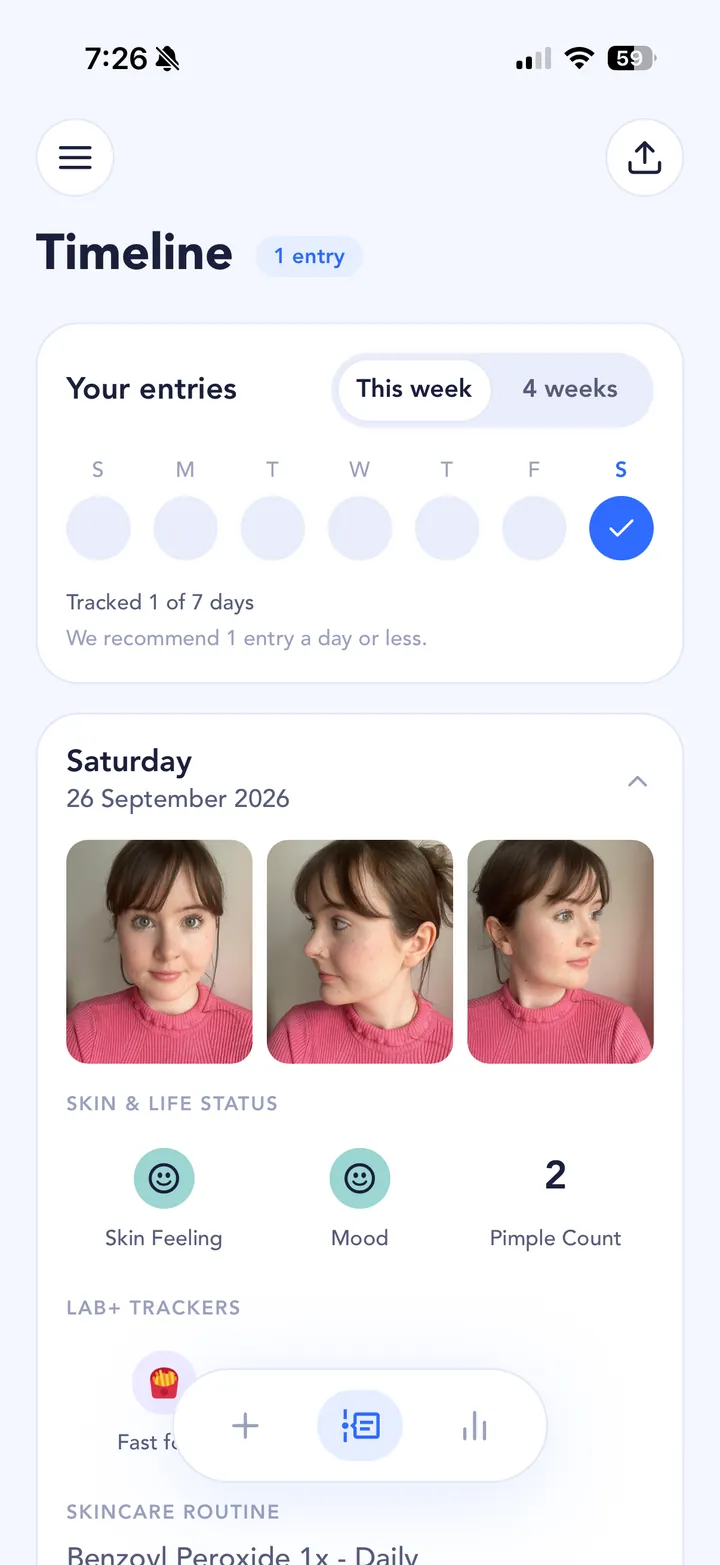
- Take three photos a day. Each entry has three skin photos, so you get front, left and right every time.
- Log skin feeling, mood and pimple count in the same entry. It takes seconds.
- Add the treatment to your skincare routine, next to your moisturiser and sunscreen, so every entry records what you were using.
- Set routine reminders for morning and night, with custom repeats, so the photos and routine don’t slip.
- Use the photo timeline as your before and after. Scroll back to day one whenever you need the reminder that it’s moving.
Was it the treatment, or something else?
A course of isotretinoin runs for months, and life doesn’t pause while you’re on it. If you get a bad week in month three, was it the medicine, or the week you slept four hours a night and lived on takeaway?
That’s the question SkinTheory is built to answer. Alongside the treatment, log the rest of your life with the Lab+ trackers: Exercise, Dairy, Fast food, Sleep, Alcohol, Water, Protein and Period. Your own data is free forever, and any two Lab+ trackers can be used free at a time. The graphs then line your pimple count up against those trackers over your last 21 entries, so you can see whether a flare lines up with the treatment or with your life.
Some places to start:
- Dairy and sugar
- Your period
- Alcohol, sleep and stress
- The gym and your bedsheets
- New skincare products, which matter more than ever when your skin is dry and sensitive
Keep the record
Your photos stay private inside SkinTheory and never go to your camera roll. You can keep the whole record on your phone for years.
That matters with isotretinoin. If acne comes back after a course, you can open the app and compare it with the first time: how bad it got, how fast it cleared, and what else was going on. Take your log to your dermatologist appointments too. Dates, photos and a mood history are far more useful than trying to remember.
A note from Conor
I had severe adult acne in my early twenties and went through Accutane more than once, along with benzoyl peroxide, tretinoin and Differin. The acne kept coming back and I didn’t know why. My photos were in Flickr and my notes were in one long Google Doc, which is a hard way to spot a pattern. What finally worked for me was getting scientific about it, and a gentler routine: moisturising more, keeping my skin clean without stripping the oils, and removing products rather than adding them. That’s why I built SkinTheory.
Questions people ask
When does Accutane start working?
It varies from person to person, and acne can get worse at the start of treatment before it improves. The NHS says a course usually lasts around 3 months and the American Academy of Dermatology says about 4 to 5, sometimes shorter or longer, so daily progress photos are the easiest way to see change that’s too slow to notice in the mirror. Your dermatologist will tell you what to expect for your course.
Is the Accutane initial breakout normal?
MedlinePlus notes that acne may get worse at the beginning of isotretinoin treatment and that this doesn’t mean the medicine isn’t working. If you’re worried about how your skin is reacting, talk to your dermatologist rather than changing anything yourself.
How do I take good Accutane progress pictures?
Take them at the same time of day, in the same light and from the same angles: front, left and right. SkinTheory asks for three photos per entry and lines them up in a timeline, so your before and after is built for you, and the photos stay out of your camera roll.
Should I track my mood on Accutane?
Yes, it’s worth noting how you feel each day. Drug labels and regulators warn that isotretinoin may cause depression and other mental health changes, and a large 2024 review of studies found no increased risk across whole populations, but that can’t rule out a reaction in one person. Report any low mood, mood changes or thoughts of self-harm to your doctor straight away.
Sources and further reading
- Isotretinoin: Overview, American Academy of Dermatology
- Isotretinoin: a medicine for severe acne, NHS
- Isotretinoin: MedlinePlus Drug Information, MedlinePlus (U.S. National Library of Medicine)
- Isotretinoin, DermNet
- iPLEDGE Risk Evaluation and Mitigation Strategy (REMS), U.S. Food and Drug Administration
- Isotretinoin prescribing requirements updated with revised risk-minimisation measures, MHRA (2026), GOV.UK
- Risk of Suicide and Psychiatric Disorders Among Isotretinoin Users: A Meta-Analysis, JAMA Dermatology (2024), via PubMed
This guide is general information written by the SkinTheory team, not medical advice. SkinTheory isn’t a medical device. For diagnosis, prescriptions or side effects, talk to a dermatologist or doctor, and bring your SkinTheory log along.