
Perioral dermatitis: what it is, how it differs from acne, and how to track it
Perioral dermatitis is a rash of small red bumps around the mouth, often set off by steroid creams or heavy face products. It's treatable but can come back.
The short answer
Perioral dermatitis is a rash of small red or skin-coloured bumps, mostly around the mouth, sometimes around the nose and eyes. The British Association of Dermatologists says it’s common and mainly affects women aged 20 to 50, though children and men get it too.
The exact cause isn’t known. The clearest link is with steroid creams used on the face, and heavy creams and cosmetics are also suspects. It’s usually treatable, but it can take weeks to months to clear and can come back. It isn’t contagious.
The one-line difference from acne: it clusters around the mouth, often with dry, flaky skin, and doesn’t cause blackheads, whiteheads or cysts.
What it looks like, and how it’s different from acne
The American Academy of Dermatology (AAD) describes it as small, red, acne-like bumps on light skin, and skin-coloured bumps on skin of colour. The skin is often dry and flaky, and it may itch or burn, or not bother you at all. DermNet adds that the strip of skin right next to the lips is often spared.
Cleveland Clinic says it can look like acne and is often mistaken for it. Some differences, from DermNet:
- Acne has blackheads and whiteheads, and can have deep lumps and cysts. These aren’t typical of perioral dermatitis.
- Rosacea usually affects older people and a different part of the face. The British Association of Dermatologists says perioral dermatitis usually doesn’t affect the cheeks and forehead.
- Seborrheic dermatitis tends to involve the hairline, scalp and chest.
Contact dermatitis, lip-licking rashes and impetigo can also look similar. Only a doctor can diagnose it.
This matters for you because the wrong treatment can make it worse. Putting a steroid cream on an “irritated” rash around your mouth is exactly what can keep perioral dermatitis going.
What sets it off
Steroid creams. This is the trigger every source agrees on. The AAD says many people develop the rash after putting a corticosteroid on their skin for too long, including over-the-counter hydrocortisone. DermNet calls steroids the most common association, and that includes inhaled and nasal steroids, not just creams. The rash often gets better for a while each time the cream goes on, then comes back worse, which is why people get stuck in a loop.
Heavy creams and cosmetics. DermNet lists cosmetics, sunscreens and occlusive moisturisers, especially paraffin or petroleum-based ones. Cleveland Clinic lists heavy face creams and moisturisers. The evidence here is weaker than for steroids: it’s mostly what dermatologists see in clinic, not controlled studies, and not everyone who uses rich creams gets this rash.
Other suspects. The AAD mentions toothpaste and allergies to things touching the skin. Cleveland Clinic lists fluorinated toothpaste, chewing gum and hormonal changes. DermNet adds hormones (the pill, pregnancy, flares before a period), and says UV light, heat and wind can make it worse. These are possible links, not proven causes, and they won’t apply to everyone.
If you think a product is involved, our skincare products guide covers how to change one thing at a time. Your period may also be worth tracking if your flares seem monthly.
How it’s treated
SkinTheory doesn’t recommend treatments and isn’t a medical device. A doctor, dermatologist or pharmacist decides what’s right for you. As an overview of what exists:
- Stopping steroids on the face, with medical help. The AAD says to stop hydrocortisone you’ve been using on your own, but to check with the doctor who prescribed any prescription steroid before stopping it. DermNet says doctors may taper a strong cream rather than stop it suddenly, and that inhaled, nasal or oral steroids you need should usually continue. Don’t stop an inhaler or tablets on your own.
- “Zero therapy”: stopping face creams and cosmetics and washing with water. See DermNet and the British Association of Dermatologists’ leaflet.
- Antiseptic or antibiotic creams for milder cases. See the British Association of Dermatologists and DermNet.
- Antibiotic tablets, often for 2 to 3 months. See the British Association of Dermatologists.
Expect it to look worse before it looks better. The AAD says the rash can get worse after you stop a steroid, and that using the steroid again “will only bring temporary relief”.
When to see a doctor
Cleveland Clinic says to see a healthcare provider as soon as the rash appears, especially if it itches or burns, and to see a dermatologist if it doesn’t clear after you stop steroid creams. See someone sooner if:
- you’re using a prescribed steroid cream, inhaler or tablets and think it’s involved. Don’t stop it without asking the prescriber.
- the rash is near your eyes or your eyes are affected. Cleveland Clinic notes some people develop pink eye.
- the flare after stopping a steroid is hard to cope with. DermNet says it can be severe, and your doctor can help.
How to track it in SkinTheory
To be upfront: SkinTheory was built for acne. Pimple count fits acne, not perioral dermatitis, and the graphs are built around pimple count. For this rash, your photo timeline and your entries are the main record. Here’s what does fit:
- The skincare routine log is the key tool. Perioral dermatitis is so tied to what you put on your face that a day-by-day record of products matters more than anything else. Log every product you use around your mouth, including any steroid cream your doctor has you on or tapering off, heavy moisturisers, sunscreen and makeup. When your routine is cut right back, the log shows exactly when each product came out, and when anything went back in.
- Three photos per entry (front, left, right) in a private timeline that never goes to your camera roll. Because steroid withdrawal can make the rash worse first, dated photos help you see whether the trend is turning, rather than judging from one bad morning.
- Skin feeling and mood in every entry, for burning, tightness and how much it’s getting to you.
- A hypothesis tested over a set number of entries, such as 21: “Does my rich night cream bring the bumps back?” Only reintroduce one product at a time, and only once your doctor agrees.
- Routine reminders to help you stick to the plan your doctor gave you.
- Lab+ trackers. If your flares seem monthly, the Period tracker fits. Any two Lab+ trackers are free at a time.
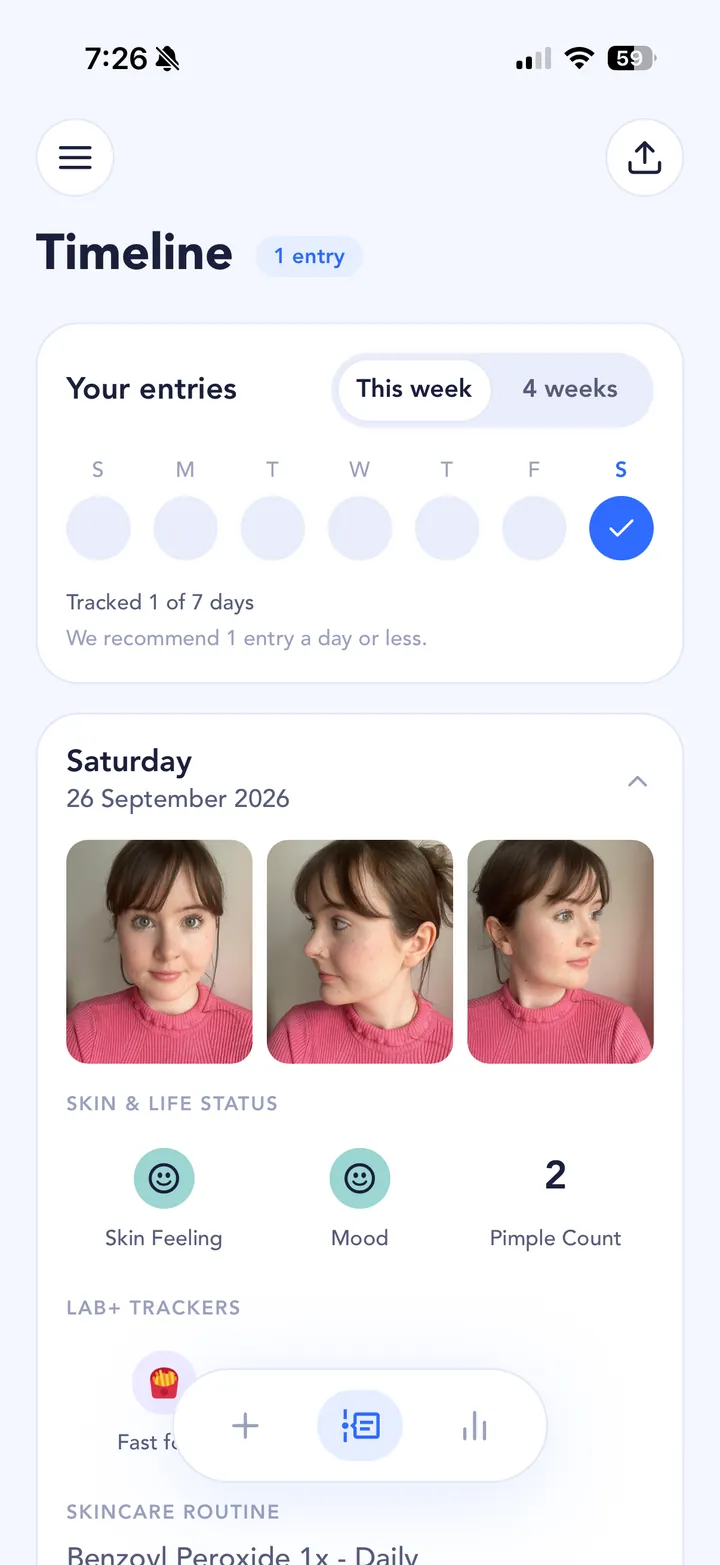
Bring your routine log and timeline to your appointment. “What have you been putting on your face?” is one of the first questions a doctor will ask, and you’ll have a dated answer. Your own data in SkinTheory is free forever.
Learn more
- Red rash around your mouth could be perioral dermatitis (American Academy of Dermatology)
- Peri-oral dermatitis (British Association of Dermatologists)
- Periorificial dermatitis (DermNet)
- Perioral Dermatitis (Cleveland Clinic)
Questions people ask
Is it perioral dermatitis or acne?
Both can look like small red bumps, and perioral dermatitis is often mistaken for acne. Perioral dermatitis sits mainly around the mouth, often with dry, flaky skin, and doesn’t cause the blackheads, whiteheads, deep lumps or cysts that point to acne. A doctor or dermatologist should make the diagnosis.
Can hydrocortisone cream cause perioral dermatitis?
Yes. The American Academy of Dermatology says many people develop this rash after putting a corticosteroid on their skin for too long, and that includes hydrocortisone. If a doctor prescribed the steroid, check with them before you stop it.
Why did my rash get worse when I stopped the steroid cream?
A flare after stopping is common, and DermNet says it can be severe after stopping a strong steroid cream suddenly. The AAD advises against starting the cream again, because it only gives temporary relief. A doctor can help you through this, and DermNet says they may taper the steroid rather than stop it all at once.
How long does perioral dermatitis take to clear?
Usually weeks to months. The AAD says it may take a few weeks to a few months to clear completely, and the British Association of Dermatologists says most people on antibiotic tablets need 2 to 3 months. It can come back.
Sources and further reading
- Red rash around your mouth could be perioral dermatitis, American Academy of Dermatology
- Periorificial dermatitis, DermNet
- Peri-oral dermatitis, British Association of Dermatologists
- Perioral Dermatitis: Treatment, Symptoms & Causes, Cleveland Clinic
This guide is general information written by the SkinTheory team, not medical advice. SkinTheory isn’t a medical device. For diagnosis, prescriptions or side effects, talk to a dermatologist or doctor, and bring your SkinTheory log along.