
Contact dermatitis: is a product irritating your skin, or are you allergic to it?
Contact dermatitis is an itchy rash caused by something touching your skin, either an irritant or an allergen. It usually clears once you avoid the cause.
The short answer
Contact dermatitis is a type of eczema caused by something touching your skin. The NHS says it usually improves or clears up once you find the trigger and avoid it. It’s not contagious.
There are two kinds. Irritant contact dermatitis happens when a substance directly damages the outer layer of your skin, and it’s the more common type. Allergic contact dermatitis happens when your immune system reacts to something you’ve become sensitised to. You can’t tell which one you have just by looking, and the only way to confirm an allergy is patch testing.
The quick difference from acne: contact dermatitis is an itchy rash where something touched you, not blackheads and pimples.
What it looks like, and how it’s different from acne
The NHS says the skin becomes itchy, blistered, dry and cracked, usually within hours or days of contact, most often on the hands and face. On lighter skin it can look red. On darker skin it can look dark brown, purple or grey. The AAD adds that burning, stinging, hives and oozing blisters can happen, and that the eyelids are a common spot because the skin there is thin.
How it differs from acne:
- It itches or burns. Acne spots can be sore, but an itchy, burning or stinging rash points away from acne.
- It follows the contact. The rash tends to sit where the product or object touched: an earlobe under an earring, a hairline after a new shampoo, the eyelids after a new eye cream.
- No blackheads or whiteheads. Contact dermatitis is a rash, not clogged pores.
A new product can cause either problem. Some products clog pores and cause breakouts, which is covered in our new skincare products guide. Others irritate the skin or cause an allergy, which is contact dermatitis. Only a doctor can diagnose it, and rashes such as atopic eczema can look very similar.
What sets it off
Contact dermatitis has a clear cause by definition: something touched your skin. The hard part is working out what. The AAD says more than 15,000 substances can cause an allergic skin reaction.
Common irritants, according to the NHS and the AAD: soaps and detergents, hand sanitisers and disinfectants, frequent handwashing or contact with water, solvents, and perfumes and preservatives in cosmetics.
Common allergens:
- Fragrance, in perfume, skin care, shampoos and many personal care products. The AAD notes that “unscented” products may still contain a masking fragrance, and that even “natural” or “clean” products can cause a reaction.
- Preservatives in cosmetics. DermNet says methylisothiazolinone, found in wash-off hair products and baby wipes, often causes an itchy red face.
- Hair dye (paraphenylenediamine) and nail products (acrylates).
- Metals such as nickel and cobalt in jewellery, piercings and phones.
- Rubber and latex, textile dyes, some medicines put on the skin, and some plants.
Two things make allergies confusing. First, the reaction is delayed: DermNet says symptoms usually appear 24 to 72 hours after contact, so the product you used today may not be the one causing today’s rash. Second, you can use something for years before you react, and once you’re sensitised, the allergy is usually lifelong.
How it’s treated
SkinTheory doesn’t recommend treatments and isn’t a medical device. A doctor, dermatologist or pharmacist decides what’s right for you. As an overview of what exists:
- Finding and avoiding the cause. This is the main treatment (NHS).
- Patch testing to confirm allergens. The NHS calls it the best way to test for a reaction to allergens, and DermNet calls it the gold standard. Patches go on your back for 2 days, then your skin is checked again a few days later because reactions take time (AAD).
- Emollients to stop the skin drying out, and steroid creams for more severe symptoms (NHS).
- Steroid tablets, only in rare severe cases covering a large area, prescribed by a doctor (NHS).
When to see a doctor
The NHS says to speak to a pharmacist if contact dermatitis is troubling you, and to see a GP if symptoms are persistent, recurrent or severe. A GP may refer you to a dermatologist for patch testing if the trigger can’t be found or treatment isn’t working.
Emergency: contact dermatitis is slow, but some reactions are fast. If, soon after contact with something, you have swelling of the throat or tongue, difficulty breathing or swallowing, wheezing, or feel faint, that may be anaphylaxis. The NHS says to call 999 (911 in the US, or your local emergency number) if you think someone is having an anaphylactic reaction.
How to track it in SkinTheory
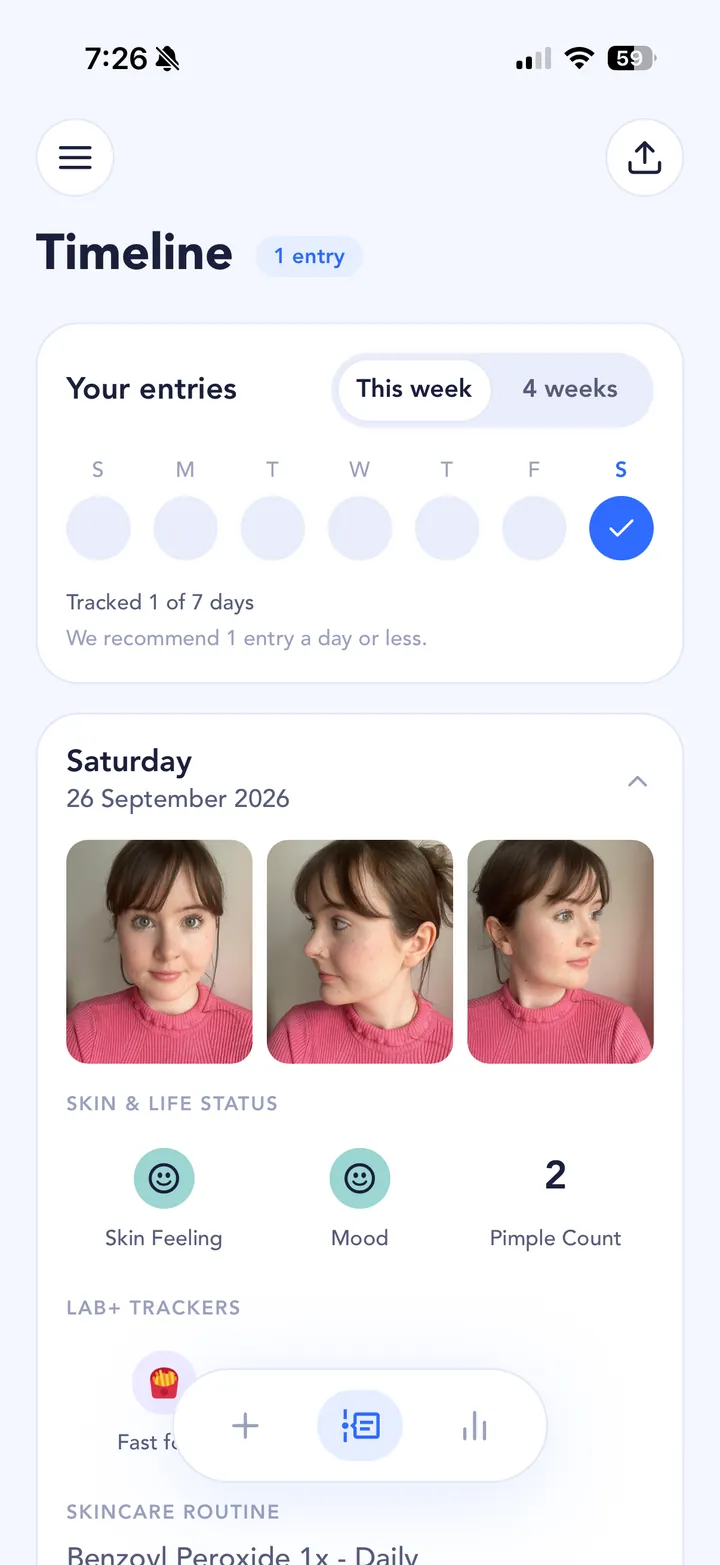
To be upfront: SkinTheory was built for acne. Pimple count fits acne, not a rash, and the graphs are built around pimple count. For contact dermatitis, your photo timeline and your entries are the main record. The useful part is that contact dermatitis is all about what touched your skin, and that’s exactly what SkinTheory’s routine log keeps.
- The skincare routine log. Log every product you used each day. Because allergic reactions are delayed by a day or more, a dated list of what you used over the last few days is far more useful than memory.
- Three photos per entry (front, left, right) in a private timeline that never goes to your camera roll, so you can see when a rash appeared and how it cleared.
- Skin feeling and mood in every entry, for itchy, burning or calm days.
- A hypothesis tested over a set number of entries, such as 21: “Does my new moisturiser make my face itch?” Add or remove one product at a time.
- Routine reminders to keep your logging consistent.
SkinTheory has no symptom, itch or medication tracker, and it can’t tell you what you’re allergic to. Your log is a list of suspects. Bring it to a GP or dermatologist, and let patch testing confirm the cause.
Your own data in SkinTheory is free forever.
Learn more
- Contact dermatitis (NHS)
- Contact dermatitis overview (American Academy of Dermatology)
- Patch testing can find what’s causing your rash (American Academy of Dermatology)
- Allergic contact dermatitis (DermNet)
Questions people ask
Is it contact dermatitis or acne?
Contact dermatitis is usually an itchy, dry, cracked or blistered rash where something touched your skin. Acne is spots: blackheads, whiteheads and pimples. A new product can cause either, so if a rash appears after you start something new, a doctor or pharmacist can help you work out which it is.
What's the difference between irritant and allergic contact dermatitis?
Irritant contact dermatitis happens when a substance such as soap, detergent or frequent water directly damages the outer layer of the skin, and the NHS says it’s the more common type. Allergic contact dermatitis is an immune reaction to something you’ve become sensitised to, such as nickel, fragrance or a preservative. Allergy is usually lifelong once it develops, according to DermNet.
How do I find out what I'm allergic to?
Patch testing, done by a dermatologist, is how skin allergens are confirmed. Small amounts of possible allergens are taped to your back for about 2 days, and your skin is checked again a few days later because reactions can take time to appear. Tracking what you used before a rash can help you and your doctor narrow it down, but it can’t replace the test.
Can I suddenly become allergic to a product I've used for years?
Yes. DermNet says someone can be exposed to an allergen for years before they react. Once you’re sensitised, even small amounts can set off the rash again.
Sources and further reading
- Contact dermatitis, NHS
- Contact dermatitis - Causes, NHS
- Contact dermatitis - Diagnosis, NHS
- Eczema types: Contact dermatitis causes, American Academy of Dermatology
- Patch testing can find what's causing your rash, American Academy of Dermatology
- Allergic Contact Dermatitis: Symptoms, Causes, and Treatment, DermNet
This guide is general information written by the SkinTheory team, not medical advice. SkinTheory isn’t a medical device. For diagnosis, prescriptions or side effects, talk to a dermatologist or doctor, and bring your SkinTheory log along.