
Eczema (atopic dermatitis): what it is, how it differs from acne, and how to track it
Eczema (atopic dermatitis) is a common, long-lasting condition that makes skin itchy, dry and inflamed. It can't be cured, but it can be controlled.
The short answer
Eczema, or atopic dermatitis, is a common condition that makes skin itchy, dry and inflamed. The AAD calls it the most common type of eczema. It usually starts in childhood but can start at any age. The National Eczema Association estimates it affects more than 9.6 million children and about 16.5 million adults in the US.
It’s chronic. The AAD says it cannot be cured, but proper treatment can control it. It tends to come in flare-ups with calmer spells in between.
The quick difference from acne: acne is about spots, while eczema is about itch and dry, inflamed patches.
What it looks like, and how it’s different from acne
The NHS lists the main signs as itchy skin that is dry, cracked, crusty, scaly or thickened, sometimes with blistering or bleeding. On lighter skin it often looks red. On darker skin it can look dark brown, purple or grey, or lighter or darker than the skin around it.
Where it shows up depends on age. The AAD says babies often get it on the cheeks, forehead or scalp, children between 2 and puberty on the elbows, knees or ankles, and adults sometimes only on the hands or feet. Teens may get small, itchy bumps instead of a weepy rash, and that’s where it can be confused with spots.
Some differences from acne:
- Itch comes first. The AAD says it tends to start with very itchy skin, and scratching often causes the rash.
- Patches, not pores. Acne forms blackheads, whiteheads and pimples around pores. Eczema forms dry, rough or thickened patches.
- Different places. Acne favours the face, chest and back. Eczema more often shows up on the elbows, knees, ankles, hands and feet.
Only a doctor can diagnose eczema. Several conditions look alike, including contact dermatitis, which is itself a type of eczema, and you can have eczema and acne at the same time.
What sets it off
Nobody knows exactly why people get eczema. The AAD says the cause is still a bit of a mystery, with genes, the immune system and a weak skin barrier all playing a role. It runs in families with eczema, asthma or hay fever.
Flares are a different question. The NHS and the National Eczema Association list common triggers. These lists come from health bodies’ guidance and what patients report, not from studies that rank each trigger, and triggers differ from person to person. The AAD adds that some people can’t find specific triggers at all.
- Products and fabrics. Soap, washing detergent, some fabrics, scratchy clothing, fragranced products and harsh skincare routines. Acne products can be harsh too; see new skincare products.
- Heat, sweat and weather. Heat, sweat, humidity and temperature changes. If workouts seem to set you off, see the gym and sweat guide.
- Allergens in the home. Pets, pollen and house-dust mites. Dust mites live in bedding, so bedsheets may be worth a look.
- Stress. Both the NHS and the NEA list it. See stress.
- Hormonal changes, such as during pregnancy (NHS).
- Skin infections, such as staph (NHS).
- Food. The NHS lists certain foods, but the AAD says that in most cases eczema is not caused or triggered by a specific allergy. Don’t cut foods out, especially for a child, without a doctor’s advice.
Itch also costs sleep. The NEA says the itch-scratch cycle can prevent a good night’s sleep, so poor sleep can be a result of eczema, not just a cause.
How it’s treated
SkinTheory doesn’t recommend treatments and isn’t a medical device. A doctor, dermatologist or pharmacist decides what’s right for you. As an overview of what exists:
- Skin care and moisturisers. Emollients used regularly and in place of soap are the basis of care (NHS).
- Creams applied to the skin. Topical steroids, plus several non-steroid prescription creams (AAD).
- Light therapy given in a clinic (AAD).
- Medicines that work through the whole body, including injected biologics and tablets, for more severe eczema (AAD, NEA).
- Treating infections when the skin becomes infected.
When to see a doctor
See a GP or doctor if you think you or your child have eczema, or if treatments aren’t helping (NHS).
Get an urgent appointment (in the UK, an urgent GP appointment or NHS 111) if the eczema:
- is blistered, crusty, leaking fluid or has spots filled with pus
- is painful, swollen or feels warm
- suddenly gets worse or gets bigger
- comes with a high temperature or you feel generally unwell
The NHS says these can be signs that eczema is infected or of a more serious condition called eczema herpeticum. The AAD describes eczema herpeticum as dome-shaped blisters with fever, tiredness and swollen glands and says it requires immediate medical care. Yellow or golden crusts can be a sign of a staph infection; the AAD says to contact your dermatologist.
How to track it in SkinTheory
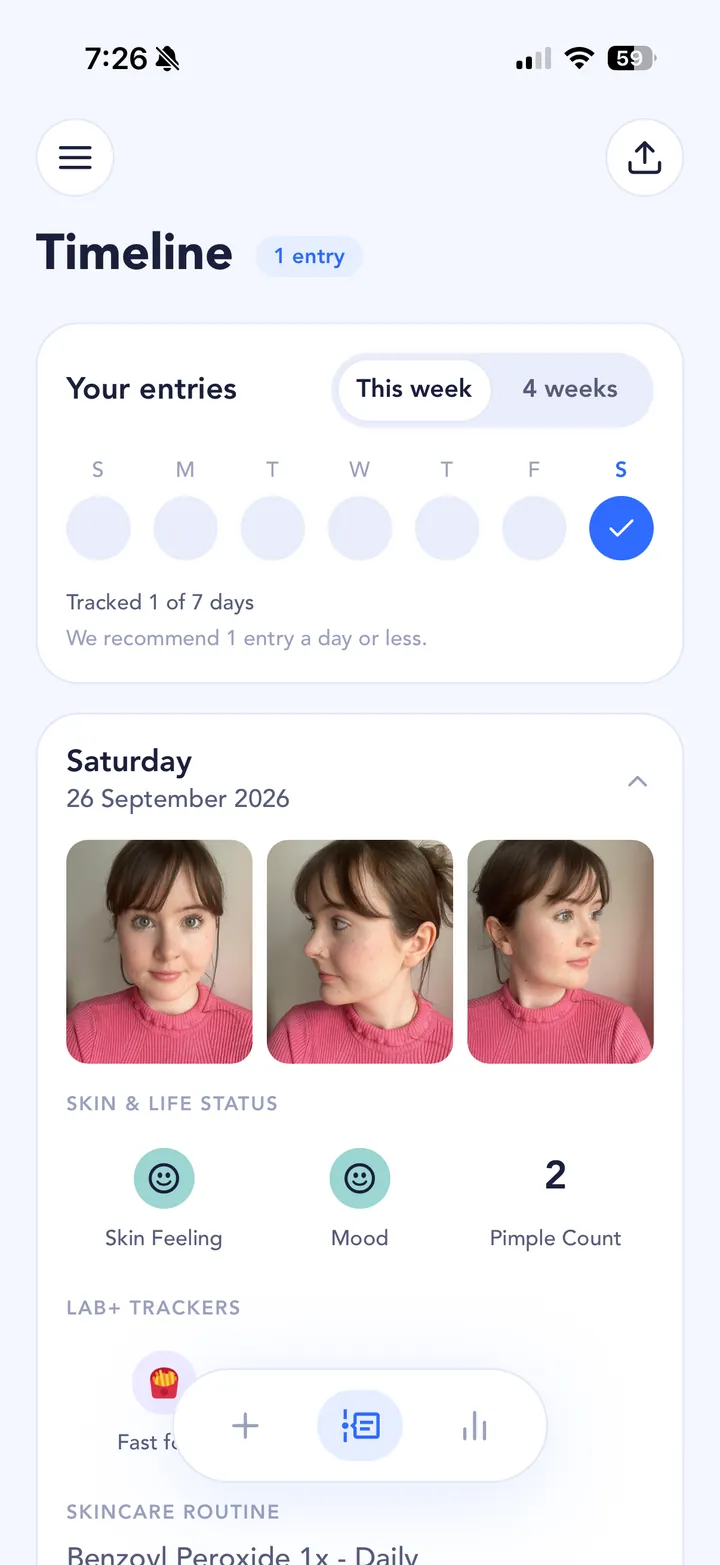
To be upfront: SkinTheory was built for acne. Pimple count fits acne, not eczema, and the graphs are built around pimple count. For eczema, your photo timeline and your entries are the main record. Here’s what does fit:
- Three photos per entry (front, left, right) in a private timeline that never goes to your camera roll. Flares come and go, and photos show how fast a patch changed better than memory does. If your eczema is on your hands or arms, take your photos of those areas consistently.
- Skin feeling and mood in every entry, which gives you a rough record of bad days and good ones.
- The skincare routine log, so you know which products you used on the day a flare started.
- A hypothesis tested over a set number of entries, such as 21: “Does my new body wash make my eczema flare?” or “Do my hands get worse after the gym?” Change one thing at a time.
- Routine reminders to help you keep up a moisturising routine your doctor has suggested.
- Lab+ trackers. Sleep and Exercise are the most relevant here. Any two Lab+ trackers are free at a time.
SkinTheory has no itch, symptom or medication tracker, so don’t expect it to score your eczema. What it gives you is a dated, private photo record next to your routine, which is useful to bring to a GP or dermatologist.
Your own data in SkinTheory is free forever.
Learn more
- Atopic eczema (NHS)
- Atopic dermatitis overview (American Academy of Dermatology)
- Atopic dermatitis diagnosis and treatment (American Academy of Dermatology)
- Atopic dermatitis (National Eczema Association)
Questions people ask
Is it eczema or acne?
Acne is mainly spots: blackheads, whiteheads and pimples. Eczema is mainly itch, with dry, cracked, scaly or thickened patches of skin, often on the elbows, knees and hands. You can have both, and some rashes look alike, so a doctor or dermatologist should make the diagnosis.
Can eczema be cured?
No. The American Academy of Dermatology says atopic dermatitis is chronic and cannot be cured, but proper treatment can control it. The NHS says symptoms often come in flare-ups and tend to ease with age.
Is eczema caused by a food allergy?
Usually not. The AAD says that in most cases atopic dermatitis is not caused or triggered by a specific allergy, although the NHS lists certain foods among possible triggers for some people. Don’t cut out foods, especially for a child, without talking to a doctor first.
Is eczema contagious?
No. The NHS says atopic eczema is not contagious. Eczema can become infected, though, and infected eczema needs a doctor quickly.
Sources and further reading
- Atopic eczema, NHS
- Eczema types: Atopic dermatitis overview, American Academy of Dermatology
- Eczema types: Atopic dermatitis symptoms, American Academy of Dermatology
- Eczema types: Atopic dermatitis causes, American Academy of Dermatology
- Eczema types: Atopic dermatitis diagnosis and treatment, American Academy of Dermatology
- Atopic Dermatitis (Eczema): Symptoms, Causes & Treatment, National Eczema Association
This guide is general information written by the SkinTheory team, not medical advice. SkinTheory isn’t a medical device. For diagnosis, prescriptions or side effects, talk to a dermatologist or doctor, and bring your SkinTheory log along.