
Seborrheic dermatitis: what it is, how it differs from acne, and how to track it
Seborrheic dermatitis is a common, long-term rash that causes flaky, greasy scale and redness on the scalp, eyebrows, sides of the nose and beard. It can be controlled, not cured.
The short answer
Seborrheic dermatitis (also called seborrhoeic eczema) is a common rash on the oily parts of the body: the scalp, eyebrows, sides of the nose, beard, ears and chest. It causes flaky, often greasy scale on red, pink or lighter patches. DermNet says it affects 3% to 12% of people. In babies it’s called cradle cap.
The exact cause is unknown. A yeast called Malassezia, which normally lives on everyone’s skin, seems to play a part. It isn’t caused by poor hygiene, isn’t an allergy and isn’t contagious. There’s no cure: in teens and adults it may clear on its own, or come and go for life.
The one-line difference from acne: it’s flaky scale and patches, not blackheads, whiteheads and pimples.
What it looks like, and how it’s different from acne
The American Academy of Dermatology (AAD) says it shows up mainly on the scalp, but also on the ears, eyebrows, beard, the skin around the nostrils and sometimes the chest. On lighter skin it tends to look red. On darker skin it often looks pink, slightly purple or lighter than the skin around it, and it can leave dark spots on the face. DermNet describes scaly, salmon-pink patches with fuzzy edges, and sometimes red, scaly eyelid edges. It may itch, though DermNet says the itch is usually mild.
Mild scalp scaling is dandruff, which the AAD says may be the mildest form of the same condition.
How it differs from acne:
- Acne is spots: blackheads, whiteheads, pimples and sometimes deeper lumps. Seborrheic dermatitis is mainly flaking and patches.
- It sits in the eyebrows, the creases beside the nose, the hairline and the beard, which acne doesn’t favour.
There’s one place they get confused. The same yeast is linked to Malassezia folliculitis, sometimes called “fungal acne”. DermNet describes it as small, uniform, itchy bumps, often on the upper back and chest, with no blackheads or whiteheads, and says it’s often mistaken for acne.
Only a doctor can diagnose seborrheic dermatitis. DermNet lists psoriasis and rosacea among the conditions that can look similar, and the AAD says several itchy rashes can look alike.
What sets it off
Most of what’s known about flares comes from dermatologists’ clinical experience and patient reports, not controlled trials. Triggers vary between people.
- Cold, dry weather. The AAD says flares are most common in winter and early spring, and that warm, humid weather often eases it. DermNet and the British Association of Dermatologists say the same.
- Stress and tiredness. The AAD, the British Association of Dermatologists and DermNet all list stress, and the last two add tiredness or lack of sleep. See our guides to stress and sleep, which cover the evidence for acne.
- Irritating products. The Primary Care Dermatology Society suggests avoiding irritants such as soaps and detergents. Our skincare products guide covers changing one product at a time.
- Some medicines and health conditions. The AAD lists certain medications, and conditions including Parkinson’s disease, HIV, depression and heavy alcohol use, as raising the risk. Don’t stop a medicine because of this; talk to the prescriber.
How it’s treated
SkinTheory doesn’t recommend treatments and isn’t a medical device. A doctor, dermatologist or pharmacist decides what’s right for you. As an overview of what exists:
- Medicated (anti-dandruff) shampoos for the scalp, some available from a pharmacist. See the AAD’s treatment page.
- Antifungal creams, gels and shampoos for the face and body. See the British Association of Dermatologists’ leaflet.
- Short courses of mild steroid creams, or non-steroid anti-inflammatory creams, for flares. See DermNet.
- Products that lift thick scale. See the British Association of Dermatologists.
- Maintenance treatment once it’s under control, because it tends to come back. See the AAD.
The AAD says babies with cradle cap should not use dandruff shampoo, so ask a doctor first.
When to see a doctor
The NHS dandruff page says to see a GP if:
- you still have symptoms after using anti-dandruff shampoo for at least 4 weeks
- your dandruff is bad or your scalp is very itchy
- your scalp is red or swollen
- you have flaky, itchy patches on your face or other parts of your body
The AAD says to contact your dermatologist if a prescription shampoo irritates your scalp or you don’t see improvement in 4 weeks. The Primary Care Dermatology Society mentions ear canals that become infected (oozing, crusting or blocked) and sore, red eyes from eyelid involvement, both worth getting checked. The British Association of Dermatologists says a severe rash that doesn’t respond to treatment may need tests for an underlying cause, such as a weakened immune system.
How to track it in SkinTheory
To be upfront: SkinTheory was built for acne. Pimple count fits acne, not seborrheic dermatitis, and the graphs are built around pimple count. For this condition, your photo timeline and your entries are the main record. Here’s what does fit:
- Three photos per entry (front, left, right) in a private timeline that never goes to your camera roll. They capture the eyebrows, sides of the nose and beard line, where facial flaking shows up. Scalp flaking is harder to photograph, so rely on skin feeling for that.
- Skin feeling and mood in every entry, for flaky, tight or itchy days.
- The skincare routine log, so you know which washes, shampoos and creams you used, and on which days. Because this condition often needs ongoing maintenance, the log shows what you were using when it came back.
- A hypothesis tested over a set number of entries, such as 21: “Does a bad week of sleep make my eyebrows flake?” Change one thing at a time.
- Routine reminders for a maintenance routine your doctor or pharmacist has suggested.
- Lab+ trackers. Sleep and Alcohol are the most relevant here. Any two Lab+ trackers are free at a time. There’s no weather or stress tracker, so note winter flares and stressful weeks through your hypothesis and mood.
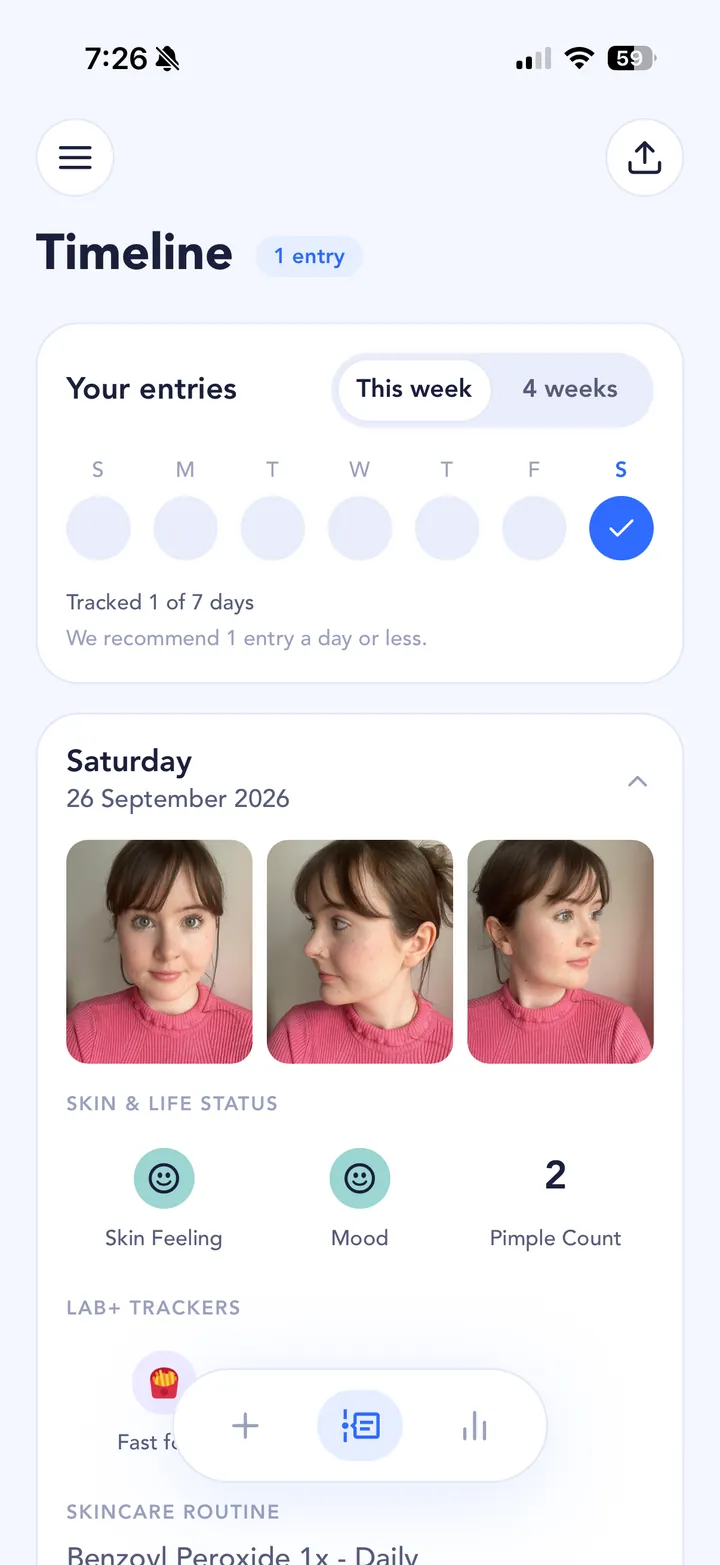
Bring your timeline and routine log to your GP, pharmacist or dermatologist. A record of what you used and when it flared makes it easier to judge whether a treatment is working. Your own data in SkinTheory is free forever.
Learn more
- Seborrheic dermatitis: Overview (American Academy of Dermatology)
- Seborrhoeic dermatitis (British Association of Dermatologists)
- Seborrhoeic dermatitis: Causes and treatment (DermNet)
- Seborrhoeic eczema (Primary Care Dermatology Society)
Questions people ask
Is it seborrheic dermatitis or acne?
Acne is mainly spots: blackheads, whiteheads and pimples. Seborrheic dermatitis is mainly flaky, greasy scale on red, pink or lighter patches, usually on the scalp, eyebrows, sides of the nose, beard and ears. You can have both, and a doctor should make the diagnosis.
Is seborrheic dermatitis the same as dandruff?
They’re related. The American Academy of Dermatology says dandruff may be the mildest form of seborrheic dermatitis, but seborrheic dermatitis also involves inflammation, which dandruff doesn’t. It can also show up on the face and chest, not just the scalp.
Is seborrheic dermatitis caused by poor hygiene?
No. The AAD says it is not caused by unclean skin and is not an allergy. It isn’t contagious either. A yeast that normally lives on everyone’s skin seems to play a part, but the exact cause is unknown.
Can seborrheic dermatitis be cured?
No. The AAD and the British Association of Dermatologists both say there’s no cure, but treatment can control it, and it often flares again when treatment stops. In some teens and adults it clears by itself; in others it comes and goes for life.
Sources and further reading
- Seborrheic dermatitis: Overview, American Academy of Dermatology
- Seborrheic dermatitis: Causes, American Academy of Dermatology
- Seborrheic dermatitis: Diagnosis and treatment, American Academy of Dermatology
- Seborrhoeic dermatitis, British Association of Dermatologists
- Seborrhoeic dermatitis: Causes and treatment, DermNet
- Seborrhoeic eczema, Primary Care Dermatology Society
This guide is general information written by the SkinTheory team, not medical advice. SkinTheory isn’t a medical device. For diagnosis, prescriptions or side effects, talk to a dermatologist or doctor, and bring your SkinTheory log along.